Showing posts with label Devaparthiva Road. Show all posts

Thursday, May 24, 2018

Our Jackfruit Tree

Many houses in olden times had ample space around them for trees and shrubs. In the Devaparthiva Road house my grandfather had purchased in 1950, there was a big jackfruit tree, among other fruit bearing trees.  This jackfruit tree with its huge girth, large canopy of leaves and tallness gave an imposing sight. It must have been planted by the first owner who built that house around 1905 or it may have been there even before.  I consider myself fortunate to have grown up in such green environs and yard space to run around, even managing to play my solo cricket on the northern side. The jackfruit tree was the start of my bowling run-up. I would bowl at a single stump and wanted to see it fly, on hitting with the cork ball. 

 Colour pictures [click on them to enlarge] in this were taken as memories during 2007-8 when we had to leave the house to move to another ancestral house in Lakshmipuram.


Cricket in the backyard [posing]. The 'umpire' was the Jackfruit tree!


That was the space for cricket. The rose apple tree is seen. The extra room in the background was built later.


Here, my cousin has climbed to pluck fruits. The branches needed periodical pruning to prevent trouble to the neighbouring house and spreading too much.  

We kept an eye on the eyes of its spiky outer rind to check their widening and yellowing, a sign of maturity.  Its fruity aroma would start wafting in the air, a hint for removal.  But sometimes, crows and monkeys would find it earlier than us, with the opened rind making the aroma stronger.  A hollow sound on slapping the rind with the palm was also a guide for removal. When the fruit was low on the trunk, just slitting the thick stalk was enough. 'Thud'!  For those that were high, a rope was tied and lowered to prevent breakage.  It was kept there for a few minutes for the latex oozed out from the cut portion.  A huge one was a pleasing sight and the first of the season 
was tastiest.


Two cousins on the tree.  See the girth of the trunk up there! I could climb only up to a certain point. 


The sweetest things come at a cost.  This one, by way of sticky latex! Smearing castor oil or coconut oil to the knife and fingers prevented the goo from sticking. In no time, a passing cow stood at the gate having picked up the sweet scent from the jackfruit filling the air.


On the left, uncle is waiting anxiously to lay his hands while cousin cuts and mother already has hers on the sweet bulbs, also called fruit pods!  When I was younger, once I had gobbled up about 40 'bulbs'!  But this figure of 40 is an utter shame.  We had a relative in Shimoga, one Suryanarayana, a renown glutton. He was known to gobble up all the fruit pods in a medium size fruit, from his own trees!  There is a separate post dedicated to his eating exploits, here: [Click]


2009 picture.  Roadside neem tree in the foreground.  The big canopy of Jackfruit is behind.

The tree also attracted jackfruit thieves at night.  They would jump over the tallish conservancy wall [above picture] and got in, but would step on the dry leaves producing a rustle.  The alert neighbour, Acharya's shout on hearing that from his adjacent kitchen made the thief fled. In the dark, we dared to go out there to chase.  The dry leaves were used for the hearth in the bath. Sometimes the dark green, roundish leaves would be plucked and served 'kosambri' during festival -- they were no-plastic days!  The pruned branches of the tree after drying provided plenty of firewood, which mother or I would chop into suitable lengths and store.  The soft wood of the tree is suited for making musical instruments like 'mridangam' and 'veena'. The thick soft seeds are nutritious, finding use in cooking with 'sambar' or roasted on charcoal, both have good taste. There are numerous dishes that can be made out of this nutritious jackfruit.

This picture of the tree was taken from the road a few years after we left and before the new owner started building his big bungalow.  In the open space [foreground, where Acharya's house existed] also a hotel building has come up. The jackfruit tree seems to have survived but suffering due to damaged roots judging by the sparsely leaved end branches that could be seen from the road behind new structures. 

Till we were in that house we got our annual supply of jackfruit and there was no jackfruit tree in our ancestral Lakshmipuram house where we had moved.  But sometimes, one or two per season were sent by our kind neighbour Lady Shenoy, from their tree.  Irresistible temptation shoots when we see good fruits with the push cart vendor [below].  The parcel is taken home, washed and savoured, at times with honey. Seasonal fruits must be eaten!


Grape-like bunch, my friend's tree.  Neighbour's tree.  Another tree in a campus.
--  --  --  --  --  --

Tuesday, May 15, 2018

Our Mango Tree

My grandfather had purchased an old house in 1950 at Devaparthiva Road, renting the ancestral Lakshmipuram house and moved after repairs. The 6 tall coconut trees and the big jackfruit tree here were likely to be planted by the first owner, may be around 1910 after constructing the house.  There were also guava, rose apple and mango in my time. 

One day, may be 1951-2, children had eaten mangoes. Among them was my grandfather's young nephew Sathya.  He had discarded a seed of his mango in a particular spot in the backyard.  It sprouted and grew.  Till Sathya lived [up to 81], he had clear memory of this.  He would take a peek at the well-grown tree each time he visited decades later. Lucky are those that grow up in a house with some fruit trees around it.  

All the pictures in this were taken in 2007-8 just before our 'ownership' of this beautiful old plot ceased.  Click on them for enlarged view.


The mango tree had grown and established itself without any extra care at all. This is where it stood, providing plenty of fruit to us. Rose-ringed parakeets, bats and monkeys had their good share too!! Monkeys feared my slingshot.  Chasing them away was fun as they were capable of rampage!   


Bunches of dangling mangoes was quite a pleasing sight! So it was when the whole tree bloomed.  We were unable to find out which variety of mango this was.  Because of its juiciness, someone suggested it to be Raspuri, but its correct identity remained a mystery. Not Raspuri, Badami or Alphonso but something probably very special.  It deserves some eulogizing.  The ripened fruit was green with a light washing of red to look at, lovely non-stringy pulp, flavourful, sweetly juicy and highly delicious to savour.  Actually it defies a proper description.  When green, it had just the right amount of sourness for pickling.


Ceramic pickle jars which were filled with diced green mangoes and stored with their necks tied with cotton cloth. Plenty of people in the family and hence, big jars!  Grandmother and mother would dice them. 

Mischievous boys would throw stones at the green mangoes dangling from the overhanging branches from the conservancy. Stones that missed their target would fall on the asbestos roof of the out house or zinc roof of the latrines and the sound would alert us.  Before we opened the backdoor and peeked into the conservancy, their swift legs would have made them 'disappear'! Now my friends boldly recall how they tried to steal our mangoes! 

View from the terrace. 

 I would pluck them by hand or with the mango plucker pole with net, either from the latrine roof or by climbing half the tree on to an easy-for-me branch if some green mangoes were needed for small-scale pickling or to prepare something like 'gojju', 'tokku', 'chitra-anna' or to give a few to some guest.  

When good-enough-for-ripening mangoes were seen in large numbers mango 'pluckers' who came by asking.  Mother would do tariff bargaining ['per hundred mangoes' plucked].  We kept track and an eye when they counted the harvested mangoes in the end.  Then we would shift them to the warmth and coziness of the store room where a bed of dry straw supplied by our kind milkman was readied to keep the fruits for ripening.

It was virtually a mango-feast.  At times during good yield, 500, 600!  But we would keep only as much as we could and all the rest went for distribution among the streetfolk, who waited eagerly. Yield of mangoes dipped every alternate year.


The penultimate year before we got to see the tree, a pair of pluckers had been called in. This is how they did.  One would drop the plucked mangoes one by one.  The other person used a gunny bag to 'catch' and absorb the force to softly drop-slide them down to the ground to prevent the slightest damage to the fruit. See combo pictures above. 

Murali [click for], a poor young boy, who also climbed the tall coconut trees, came to pluck.  He slipped and fell once, luckily on the latrine roof with very minor injuries and we were reluctant to hire him thereafter as he was epileptic.


[Jackfruit tree in the background. Photo by cousin Santosh]

Imagine me sitting on those steps that faced the mango tree savouring whole juicy mangoes.  A careful bite at the beak opened for stripping the skin further.  I sometimes ate the skin if it was good. Then, I buried the front teeth into the pulp to pick up piece by piece till the kernel was completely scraped making it white!  The excited bites were to such an extent that little fibres would get caught between the teeth and trying to remove them later was tricky!   It was also not unusual for the juice to trickle down to my elbow to stain my pyjamas and a few drops would escape the mouth unnoticed and stain the shirt!  So juicy were these mangoes, ripened the traditional way!  Have eaten tens of them each season often sitting there, swishing away fruit flies that hovered around the eyes as they were also in proliferation in summer. 

When many ripened at the same time, 'Seekarnay' would be prepared [mashed pulp, milk and some sugar].  Mango leaves for auspicious occasions were readily available, esp. for flagging the doorframe. 

During strong storms tens of mangoes fell away, but not wasted.  When a hailstorm came about, that would mean fruits would rot during ripening.  


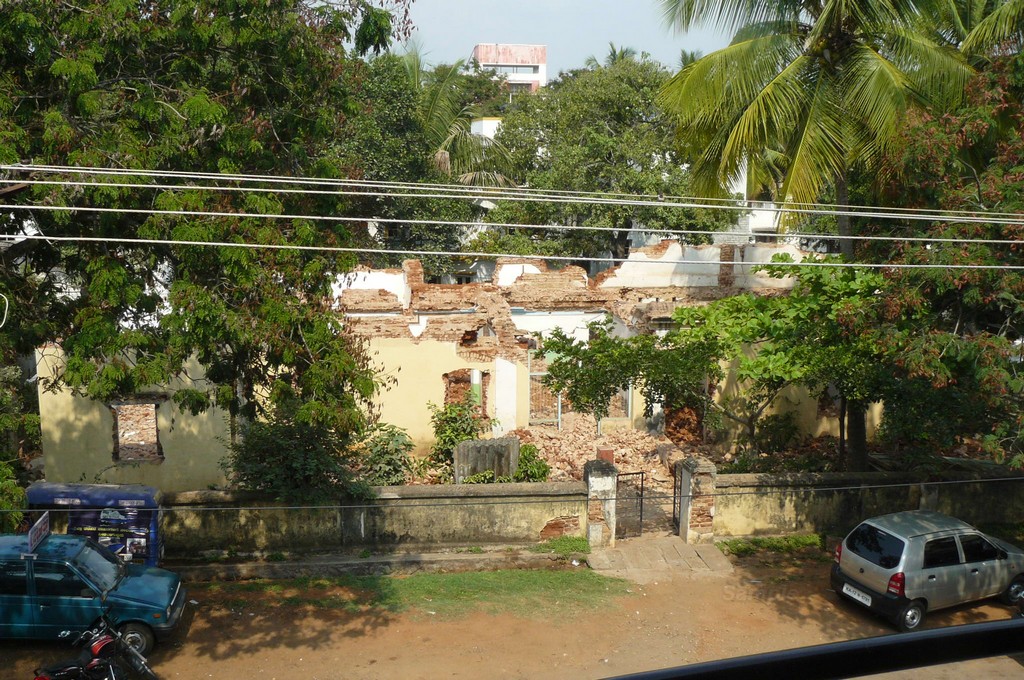
Old house being torn down by new owner.  Mango tree seen at the back. 2012.


New owner's bungalow under construction, 2016

The only occasions when we ate 'purchased mangoes' during our tenure there were during seasons of low yield.  Mr. Salar Masood [a paint merchant and old client of my grandfather] would supply a basket of mangoes upon request by my grandfather.  We never knew how much he used to pay for them. 

An unusual thing happened after we left this house [Devaparthiva Road]. People observed that there was no flowering and no mangoes the following season!  Tests have proved that trees and plants can bond and feel the human care-takers' emotions.  Was our beloved mango tree also feeling the absence and its chemistry temporarily altered and showed its suffering in that manner? Not once had this happened before. When the new owner dug for foundation very close to the tree for his new bungalow a few years later, it is likely that its roots were severely damaged. 

Henceforth, no longer could the neighbourhood get the taste of those mangoes and they felt as sad seeing the tree slowly dying as us looking in that direction as we passed by. People said they tried to save it, but it was futile. The loss is theirs. 

What remain with us are sweetest memories of our beloved mango tree and the most delightful fragrance of the sap filling the air when the dangling fruit was pulled from the stalk.
I consider myself lucky to have grown up in that house with such useful trees and shrubs in the yard.

-|o|o|o|o|o|o|-


There was a mango tree in the ancestral Lakshmipuram house [half razed in the picture] also where we moved. The tree's reputation was so so, but it did bloom profusely only once and gave some fruit, as if to welcome us.  Thereafter, hardly 4-5 or none!  It was an ordinary variety. The new owner of that divided portion now has chopped all trees to make way for his new structure. 


Now, our own mango plucker pole was idle laying in the open shed.  Our Red Whiskered Bulbuls found it a suitable place for nesting!  It has used the same nest 6-7 times, renovating it each time, making babies. Many little ones fledged while many eggs were feasted by the Mynas.


"King of fruits"

We have to content ourselves to buying mangoes.  Artificial ripening using calcium carbide [health hazard] has become so rampant in recent years so much so that one must exercise caution in choosing the outlets selling naturally ripened fruits. 

It is no surprise that my fondness for eating mangoes is as great as it was drawing a mango and colouring it during childhood, like this, with a prominent 'beak'!


..mangomangomangomangom..

Sunday, May 6, 2018

My time with CHESS

My exposure to chess was from an early age.  The earliest I can recall having been taught the basic movements of chess pieces was by cousin Manjunath. He had been sent from Bangalore to study his engineering here. I was in 7th class or so and I would watch him play with a friend.  At times he would be reminded by my grandmother to study because he engaged himself playing chess during his exam time.  He had an excuse, one that I would adapt years later, saying that the game of chess would improve concentration and memory.  But it was not enough to convince her. 

In those beautiful times so many board games were played within the family and among the children in the streets as well.  Nobody at home was playing chess before Manju's entry and stay for just 3 years until his end came shockingly.  Probably my father and grandfather also knew chess, I know not.  I think, someone brought his chess set here to play till the time I was bought one.  I had picked up the game easily by playing with friends, sometimes guided by Manju in the early stages as he watched us play.  After Saturday's 'morning class', I remember my friend Gopi coming to play during high school days. In later years Sridhara, MG Ravi and several others came to play. It was a fantastic pastime.


[Click on images to see magnified view]

One of the early 'toys' that came to us was this plastic set [above], most likely purchased at the Dasara Exhibition where toy shops were a great attraction.  Luckily, all pieces are in tact! The paper and cardboard chessboard did not last long.

Showing a few of our heirloom dolls, my grandmother used to mention these are 'Chaduranga pawns' [the old name of chess]. A few have survived. Extreme left must be the 'King'. 


It was in my high school days that I played chess more often than at any other time in my later life. In early college days, Shankar used to bring his father's popular chess book written by a champion in the 50s in which famous games played by J.R.Capablanca, Boris Spassky, et al were recorded.  We replayed a few to see how intelligently they moved their pieces in different types of openings, endings and gambits.  Our newspaper's weekly supplement also carried notes on chess games which I curiously studied.


Shankar's book was something like this, showing moves. They were in 'P-K4' [Pawn to King Four] numbering. The chessboard numbering was later modified as 1-8 and a-h to which I never got familiar.

During the annual day sports events at the 'Keerthi Typing Institute' which I was attending in 1973-4, I took part in chess.  I beat two people and lost to the next having run out of patience as they were played in a chain.  I learnt patience and calm thinking were keys to 'holding fort' in chess! 

There was an interesting, very active, old retired govt. doctor in the opposite 'Liver House', Dr.Rama Shastry.  He carried a nickname of 'Bappu', very intelligent chess player with great expertise.  I had seen him play with his old friend as I used to go there whenever I pleased.  A huge vintage desk and his bed occupied most of his tiny room. He mostly lay on  his bed due to a chronic back problem, but sat up during play or whenever he had to go out.

Bappu had known I could give good chess games.  So I went to him nearly every evening in the mid to late 70s and we would play 2-3 games.  It was also providing me good experience.  It was a challenge to play well against him. It was from him that I learnt that the white corner square has to be to our right.  He was extremely hard to beat but I have the privilege of checkmating him once, just once in a hundred plus games we played!  That evening I felt like having won something very big that deserved a newspaper headline!  It was the first time I saw him sheepishly struggling to see himself a loser while I was enjoying my ecstasy!  But he was happy for me.  He was also one of the old generation players who used the word 'Shah' for 'check' in chess. 'Shah' is a Persian word to warn the opponent King thus.

Bappu's chessboard was a big one.  He had 'laminated' it with a thin white cloth for durability. The wood pieces were large and beautiful.  I wanted to have one such of my own! 


This small cane table was a gift to a one-year-old me from the family.  My carpentry and painting skills were useful to make a large chessboard from the available pieces of hard board at home.  Nailed it to the table-top so that it also protected the cane surface.


1978 it was. Endless number of games were played on it. 


If my memory serves right, it was Bappu who also suggested me the shop where these wooden chess pieces were sold - DVG Road, Gandhi Bazar, Bangalore, luckily it was close to the place where my relative/s were. On my next visit to Bangalore - must be 1980, league cricket had taken me there - I was in utter glee when the shopkeeper showed me what I was looking for!  It was a small shop that sold board games and other small items.  I used the pocket money plus a small sum borrowed from father to purchase.  The neat wooden box has a sliding lid. Later I pasted gift paper on it for a colourful look.


Beautifully crafted wooden pieces. 


Not so beautiful!

Some family friend was visiting one day when I and brother were engaged in chess. There was a little boy who had accompanied them. After they were gone, we found one pawn missing. I felt very angry and bad. Using my carpentry skills, I made the replacement using balsa wood, pieces of which I had from my aeroplane making [a little story in another blog].

Aside from Bappu, I used to play with one Masood. He was the brother of my good friend Zakir whom I used to visit every now and then [sons of Dr.B.Sheik Ali, VC of two Varsities].  Masood [no more now] was also a very good player and I am proud to have beat him once, trapping the castled rook and king - he had failed to spot my simple plan!

The last I played frequently was in the mid 80s, with Sanjay [Geeta Book House family], much younger to me. He was playing well and I used to beat him more often.  He remembers those enjoyable games even now.  It was a lot of fun.  One Sandeep, who was also from our friends group used to join. 

This Sandeep played good chess.  He and his friend Sid[dharth] Mookerji [who now owns SPI] played chess 'in the mail' as Sid was in another city. In each letter they would write a chess move and thus one game would extend several months!  And when computers came to workplaces, I tried to play chess 'with the computer' but never found it interesting. It was 'more intelligent' than me!  Perhaps it contributed a little bit in diluting my enthusiasm to play, what with not finding interested people. But not for nothing the game of Chess is so popular worldwide.  

It is unfortunate that the electronic-gadgets-distracted younger generation is completely unaware of the beauty of this great game.

Do you know chess?  How proudly we used to say 'YES'!

Wednesday, July 22, 2015

Ganapathi, his whistle and more

Living opposite our house on Devaparthiva Road, was one humble Iyer family.  Ramaswamy Iyer and his wife had five children. The third one was Ganapathi, a boy slightly elder to me.  He was a very talented chap, my nemesis in many games we used to play against each other.


The Iyer family lived in the [rented] house seen with a green door at the back. Our tenant enters our premise.  Photo may be from 2001 or so. The houses have undergone facelift since the 60s. We no longer live in this street. The Iyer family left in the early 70s. The opposite row of houses had a common wall between them!

Ganapathi was an expert player in tops.  His top had a 'narrow design'.  His rope was unique.  It was short in length and stout which he himself had made using other threads.  The length was so short that he would load in a jiffy, spin and lift it into the hand using the rope while it was still spinning, as per rules. His swiftness coupled with the shortness of his rope ensured he spun the top a lot earlier than the opponent and hence ended up with a win.  I would still be winding my lengthy rope with Ganapathi watching me with a teasing look!  Sometimes the tip of my rope would tangle with the pivot nail.  It was a pleasing sight for Ganapathi!

In another variant of the game, the loser would keep his top on the ground in a drawn circle.  Others had to hit this top with theirs and spun their top in one action to dislodge it out of the drawn circle.  Ganapathi's aim was incredibly accurate and he seldom missed the target top.  His top's pivot nail was stout and sharp, meant to damage and even break the opponent's top!  He would hit very hard and deface it with deep dimpled nail marks. That was the game, in fact.  It was a great joy for the boys [in case of more than two players] who caused the dimples and identify them which mark was made by whom as they kept their pivots on the dimple to prove!  It was agonizing to see my defaced top while Ganapathi derived great pleasure! He ALWAYS won. He was an undoubted hero of the street.


A top from those days, cracked by time and not by Ganapathi. This is nearly how his top was like.


The big top on the right is not mine. It is a mysterious top which came rolling to our door one afternoon in the early 70s and I know not from where it came.  There appeared to be no one in the street playing when I went out to check! 


Only a few of these marbles are from those times, the roughened ones. 

Playing marbles, Ganapathi was very nearly invincible with his laser-sharp aim.  He played with his right hand while I was comfortable with my left [middle finger]. He stocked an enviable number [he kept count] of marbles he won in 4-5 beverage tin fulls!  It was testimony to his amazing skills.  He would proudly show the tin fulls when I went to his house.  When he poured the marbles out to show, the very sound of so many marbles was music!  I wanted to win like him, but it was impossible with boys like Ganapathi!  I would buy marbles, new and shiny, ten marbles for ten paisa at Shetty's shop on Sayyaji Rao Road. Ganapathi used to win most of them!  He was dynamic, elder, experienced, bold and talented.  He did not cheat, but he loved teasing.

Win he would in the little games with marbles for which matchbox labels were kept at stake. He had bundles of them to show!  All the boys lost to him.

At Gulli-danda game, the side in which he was in usually won.  In the absence of a Carrom board, he wrote the board with chalk on the floor of his house.  His sisters would join the game. It was quite a funny feeling with no 'rebounds' possible!  He was good at drawing and he used to show me his sketch book which was stitched from left over pages of old, note books without lines. I am sure he would have made that book too.

 There was a game for which we collected empty cigarette packs, folded and piled, kept in a circle and took turns to disperse out of the circle with the striker - a flat piece of stone - to win. Ganapathi would hit the target unerringly and grab all at stake kept in the circle!  Seldom did he miss.  At the game of Lagori also he was very good.

Ganapathi was adept in whistling with the fingers in different styles.  He would also make a few types with ordinary things like some bamboo pieces and bicycle tube rubber.  He had made a beautiful slingshot with which he would hit the target, usually some fruit or for fun with such aim that was truly astonishing.

Among the many other little things like those,  the one thing I still admire was his ingenuity in making a 'pea whistle'.  A real pea whistle would be like this, used by army officers, the police and sports masters.

Our genius Ganapathy made his own from real scrap. It was crude, but it worked... 'prrrreeeep... prrrrrreeeeeep'.  I tried to recall by trying to replicate the whistle 42-43 years since I saw Ganapathi's work.  I remember I had made one at that time also.  We needed an old wall calendar with its pages bound like this - with a thin tin strip.  In those days, this was the only type we had and the spring bound calendars had not arrived.


Unfold the tin strip and separate from the calendar paper. Just a length of about 4-5 inches is all that is required to make the whistle.


Flatten this portion, cut it.


Bend the piece like this.


I do not know how Ganapathi made this air-escape hole, but I punched the hole with a poker and flattened it. 


The 'mouth piece' which I had slightly rounded to blow air in was wrapped with paper to prevent air leakage from the sides.  Again, I cannot recall clearly how our genius used to make. I bent slightly at the hole for the blown air to enter the curved area that would house the 'whirring' seed.  The open sides were held closed by the thumb and another fingertip after putting the 'seed' in it.


Ganapathi used a star gooseberry seed but I found a Mirabilis jalapa plant seed [below] in my garden to serve the purpose.  


Ganapathi's whistle made a pleasing little 'prrrrreeeeep'. The seed had to be saved each time we removed the fingers from the whistle.  My latest project whistle produced 'Ssrrrssssrrrsssssss'.  Do not miss the 'r' that is the sound produced by the blown seed trapped in the gap, I need to adjust the angle of the air blow and I am sure to re-tune the true 'prrreeeeepp' some time.  
But then this is just for the idea how our genius Ganapathi did from things that one expected!