Showing posts with label Mysore. Show all posts

Wednesday, May 18, 2016

N.S. Sitaram - tribute to a teacher

On Saturday 14th May, 2016, I passed very close to the house of my high school teacher NSS [N.S.Sitaram] on the way to the market.  There were thoughts of stopping by for a minute to say a respectful hello to him. But I did not. I had been longing to meet, pay respects and take his photo, but kept procrastinating.  Our houses are not very far apart, may be one kilometre.
The evening paper of 16th May had this to shock me:


It was terrible news considering what I failed to do just two days ago.  He had died on Sunday.

Sarada Vilas High School [for boys] is an old institution with a very fine reputation through its dedicated teachers who had moulded characters and imparted great knowledge and culture to its pupils, some of whom becoming famous nationally and internationally.  


2009 photo of our school. [Click to enlarge]

NSS was one among the great teachers who had served there for a long period of time and retired as Head Master.  My father and uncle were also students in that school around the mid 1940s, but it may be before the time NSS joined. When I joined in 1970, NSS was the Asst. Head Master. When I passed out from 10th, he had succeeded Sri M.N.Lakshminarasimhaiah as Head Master. His signatures are on my Admission Ticket as well as Marks Card. 


NSS came on his bicycle clad in a simple mull-cloth ಕಚ್ಚೆ ಪಂಚೆ [white dhoti], leather sandals, light gray 'close-collared' coat, old but neat, worn on a white, long tailed, full-sleeved shirt, the same length of the coat.  His headgear was a black ಟೋಪಿ [stiff cap] and he wore a wrist watch.  His fair-face had features one had to appreciate.  His eyes required a pair of spectacles for short-sight.  The costume was typical of the older generation Mysorean 'school masters'.  We were fortunate to have been students of this 'last batch' of them.  

I try to roughly show how NSS appeared.


[Or did he wear an open collared coat that exposed the two shirt buttons?]

The cardboard headgear used to be like this [without the dark band shown here]:
Click on the image for larger view.

It was a delight to see his writing on the blackboard, the letters forming neatly, equal in size and uniformly white.  He held his chalk softly and never seemed to apply any pressure as he wrote sum after sum.  It was also something as much appreciated as his teaching.

NSS' forte was Mathematics, but used to fill in with some English or Science subject occasionally when that teacher was on leave.  He used to take Algebra which most students remember for his fine method of making the difficult subject to be understood easily [I admit I was an exception!].

He was a very lovable and approachable teacher, mild mannered but strict.  When NSS walked in there would be silence.  He was never armed with a stick for lashing [like MRK], or needed to slap any boy [like KRK] if the homework was not completed or some sum was wrongly answered or someone was not attentive in the class.  He would correct it so that the pupil learnt.  NSS was never one to get teased or his dhoti pulled by mischievous boys, [we heard they did it to one VSS who also came in a dhoti] but was one who had commanded respect through his dignity and quality as a teacher.  Yet, on the lighter side, he had been nicknamed in Kannada for fun, like other teachers' initials also, as ನೊಣ ಸಾಯಿಸೊ ಶೂರ [Fly killing expert] to expand his initials of NSS.

The last I met NSS was about 5-6 years ago.  He had said "86" when I asked his age.  He had been on his walk on Krishnaraja Boulevard when I was on my bicycle on my way home.  I had the opportunity to walk with him pushing my bicycle along for a long way, while we talked on a few subjects, also of moral values, teaching standards and the teachers of my time.  I had told him I would take him on the scooter to his contemporary PV's house one day.  This never happened and PV also passed away last year.  He was our history teacher.

"Wow, our NSS", I used to mentally exclaim on seeing him walk leisurely in front of our house and along the calmer streets in the area, clad in his simple white dhoti and white shirt.   At times I went closer to be seen and bowed the head to greet.  He had mentioned why he had chosen the time for his walk which was an hour before noon - low density of traffic.  I remember him having mentioned of his normal health and kept himself active with a long walk daily.  He used to be in my thoughts often, because of some unexplainable, special admiration and impression.  He had known my grandfather also.  About 10 years ago we wanted to put our daughter for maths tution with him, but it did not work out.  I had gone to his house for this and had taken the opportunity to get his blessing by prostrating at his feet as an old student.
Another great old timer now joins light, aged 91.
May his soul rest in peace.

------------
More school memories are in this separate post: [Click here].

Friday, October 16, 2015

How I stumbled at Ravi, old mate

"Ravi" has always been my favourite name.  I have always wished it to be mine, so much so that on certain occasions I have even answered my name as "Ravi", of course where it has not mattered.  In Sanskrit, both names mean the same, 'Sun'.  No wonder Ravi is such a common name.  It may not be as common as 'Smith' in London's telephone directory!  This piece is about a dear friend of mine, one of the many Ravis in my list!

"H.R.Ravi" was my brilliant classmate from Class 1, up to 10, with the exception of a few when he studied in some other school.


Class 2 Photo - Me in front of Ravi, coincidence. Me, next to suit-boy Ramu.
{Click to enlarge all images}

My fondness for this fine fellow is from a young age.  Reasons may be for his brilliance, neatness, gentleness, his crop of hair, skill with drawing, handwriting and soft speech, to name some.  He was often a topper in class, shuffling with Zakir or Sujaya but I was never one that fought to dislodge any of them at the top which appeared to be way beyond my reach!  Only once in Class 4 or 5, my rank was 4th and that too in a class test.  I had literally ran home all the way with the report card in hand, in glee, to show it off!  The next highest I can recall was #12.

Many of us had exchanged little messages in our little autograph books when boys had to leave the "Christ the King Convent" after Class 7th. I remember having taken his in mine and he had written something like this (unclear recollection): "Forget me not.... HR Ravi". 

We found ourselves in the same class at "Sarada Vilas High School", for Class 8.  On many Saturdays Ravi and I used to play chess in our house and at times Gopi [another mate] would also join. The Saturday morning school closed at 11 am allowing us plenty of play time, homework, "afterwards"!  After Class 10, we separated for college and lost contact.  I had also lost my invaluable little autograph book at the very end of 10th.  In it were all the lovely words my little mates and teachers had written.  I miss this.

Ravi and I seemed to have a fine rapport. He was good in whatever he did. His Gandhi face caricature was highly impressive.  I can never forget how beautifully he drew it on the middle-school blackboard during the short period breaks.  I have kept imitating this all the way through!


Two pages from my wild sketchbook, 1983.  


CKC Alumni Meet, 2011. Ravi does what he used to do, same class room, 35 years back.

Around the mid 80s, I was on a stroll on Avenue Road in Bangalore, trying to locate uncle Chandu's office. League cricket had taken me there and I made use of the evenings to meet relatives.  A familiar face appeared to cross me.  I knew it was HR Ravi.  We stopped, exchanged excited and happy faces!  His home, an old one as I can recall, was a few feet away, upstairs, entry to which was not easy to locate as it was among the long row of shops in that busy road.  He took me in.

If my memory serves right, he was studying for a post graduation degree in medicine at that time. Such things are suited to people like Ravi's intellect!  I was really happy he was in the process of becoming a specialist-doctor.  We exchanged some school memories and then I left.  He had come down to the street on some errand which proved lucky to me to find him, but this luck ended there!  Mistake - not taking his address, to keep in touch further. So I lost him again thereafter.

Many years clipped past.  Ravi's welfare and whereabouts remained a mystery to me.  Each time I drew a Gandhi face in the sketch book, I remembered Ravi.  I could not think of any common friend to inquire.

Came 2004 September.  I was in Bangalore, again for cricket.  Our Guest House was opposite Manipal Hospital where we stayed for 4-5 days.  Each evening some of our team mates would go either to the telephone booth in the hospital premises to call our homes or to eat something in the adjacent canteen for a change.  Cellphones were slowly arriving at that time.  The telephone booth was attached to the hospital building.

One night, I was waiting for my friend using the booth.  Casually looking here and there in the eerie corridors of the huge hospital, a board showing "Dr.H.R.Ravi" caught my eye.  My joy knew no bounds. To me, there could be only one HR Ravi!  Immediately, I went to the inquiry desk and got his residence telephone number - landline of course.  I called from the booth the very next evening.  "Did you study at CKC in Mysore?"  I knew he would say 'yes'.  Hurray!  In turn, he was astonished the way I found him, yet again. In fact, in the preceding 4-5 years, I had hunted and gathered old mates back, after a gap of 30-35 years and in the next 5-8 years many got added, much to the delight of everyone and to my own satisfaction of seeing many old mates reunite.

With communication facilities expanding everywhere, we have since found it easy to keep in touch.  We have minded to do it, also with many of our mates from Class 1.


Dr.Ravi visits my home, 2008.

Ravi and I met on a few occasions thereafter, also visiting each other's homes.  He has earned great respect among his patients in various hospitals he worked as a surgeon.  Talented, intelligent and skilled as he is, it is no surprise he has earned a high reputation in his specialized profession now and it makes me proud to have him as a friend and having known him for this long!  He has not changed. He did not.

Some pictures and short notes:


2011 Alumni Meet, we meet the most feared Maths teacher. Ravi shows Sr.Prudentia her own signature/autograph he got in 1970. Rajaram, Ebby and yours truly look on.


Ravi shows the same to Miss Leela, the much loved Hindi language teacher. Her expression and mate Rajgopal's need no description


"How to be good". This is a book Ravi presented me in 1970. 


Though I lost the autograph book, at least his writing remains here in this book, on morals. 


Here is a sample of a couple of pages.  I must admit I have never read the book. May be if I had done so, the world would have seen a better person!  But I can guess why Ravi was so much better at that age and later became a respected surgeon, teacher, person.  It is my privilege to have known him. 

Wednesday, September 23, 2015

Tribute to Krishna Vattam


My father stopped when he saw his friend, a tall bespectacled man, walking in the opposite direction in the sparse crowd near the Dufferin Clock Tower. "This is Krishna Vattam, working with Deccan Herald" he introduced him to me.  My father was 'walking' the bicycle with me beside at that moment.  We had been to the market on one of the weekend morning trips.  This was in the early 1970s.  It was my first glimpse of Krishna Vattam, to the eye and the name to my ears.


We were getting Deccan Herald's sister in Kannada, "Prajavani", but I was not reading papers at that playful age. Years passed and we shifted over to Deccan Herald, also a popular English newspaper. I had started to browse some news or articles in addition to comic strips.  Seeing the name "Krishna Vattam" in print itself thrilled me, only because I had met the man.  In those adolescent years, I had no interest in reading the full content of his writings. But I had become aware of Vattam's reputation as a very good writer.

Some more years passed.  He was seen on the street or somewhere. I usually stopped to say hello. At other times, he would be on his blue Lambretta scooter, later replaced by a blue Chetak, which he used till his early 70s.  The warmth of the man and the affectionate smile that readily emerged from his mustached face was of a magnetic sort.  Like a password, I would introduce myself referring my father's name which he seemed to remember, among the thousands of his acquaintances. This happened many times.  The frequency led to a stage when he remembered my name, because my letters to the editor of a local paper were now appearing occasionally and as one would expect of a person of his involvement in the local affairs, would notice that column.

In the 80s, his house had become a very popular landmark, just off Jhansi Lakshmi Bai Road, adjacent to the Silk Farm on the road leading to Vidyaranyapuram.  If someone had to guide to a location in that area, "Vattam's house" was the index. Everyone seemed to know it.

After a long and very distinguished service he retired.  A few years later he joined as editor of a local eveninger, Mysore Mail which was located close to my house.  Occasionally I would go in there and say hello to him and to see the wrinkles on his face, which was wisdom personified.  They say each wrinkle had a story of its own and he was a man full of stories from his long experience.  In fact, as one would expect, he has put them down in many an article and a book.  I had not been aware he was a cancer survivor until I read an article he wrote in the local paper.  He was one Mysorean who knew the old city very well and a few times our discussions were about the heritage too. He was well versed in many subjects and his expression was crystal clear, his writing simple yet emphatically conveyed the purpose in full.

I had door crashed his house a few times whenever I went to the scooter mechanic 'Bogadi Srinivas' right opposite his house. One such turned out to be my last glimpse, last year.  He had breathed his last on July 27. The papers were filled with news and tributes. Just a month before this happened, his beloved granddaughter who lives on the other side of the planet had visited him. She had hinted me to go and meet him as he had been weak. But I was not destined to. The Krishna Vattam era had ended.

A certain G.V.Krishnan, a retired pressman had come to settle in Mysore.  It was he who brought us closer, through 'blogging'.  And it was through GVK I came to know that Lakshmi Bharadwaj, a young blogger, now already writer, was none other than Vattam's grand daughter!.  In one of my earliest mails Lakshmi wrote: "Sir, you know thatha? that's great! :-) He's really into journalism and he's the one who basically encouraged me to take to blogging, although he himself prefers to write for the papers more than to write for his blog!! :-)"  After a few years GVK left Mysore for Chennai. At a small farewell to him we gathered, including Vattam.  


"Bloggers"


We wait for GVK's arrival that evening.  He is holding Lakshmi's poem in praise of GVK which he read later.


I brought Vattam home on my scooter on the way before dropping him to his.  
No amount of tribute will do justice to a person of Vattam's stature, which was simplicity personified as well.


Monday, August 3, 2015

Nandi Bull of Chamundi Hill

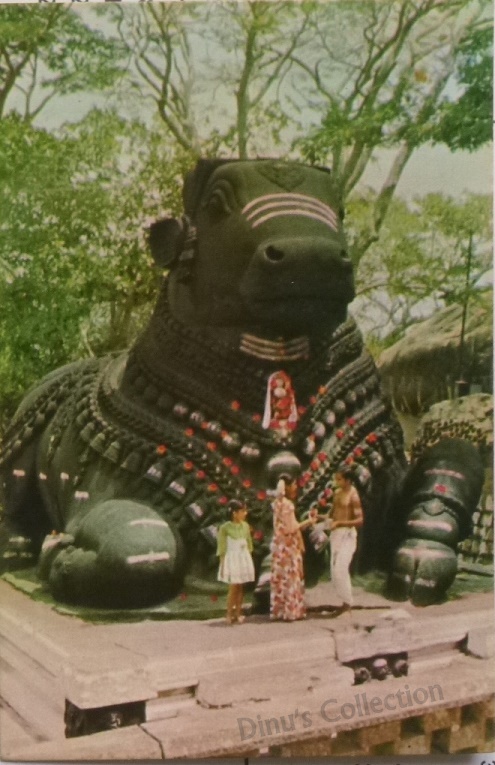
At the outset, see some of the very old and rare pictures [click on them to view larger] of the Nandi Bull on our Mysore's Chamundi Hill. The old images are gathered from the web, years shown on them were as in their websites. The colour images are taken by me.  The one of Dodda Devaraja Wadiyar was kindly shared by Sri Nagaraj Gargya.


Photo by William Henry Pigou.


Nandi Bull can be found in all Shiva Temples.  In fact, there is also a small cave temple, carved under an overhanging boulder, close to its left. Also, the Hill's original shrine is of Lord Shiva [Mahabala] but the temple of Goddess Chamundi became famous in the 18th century. 


Above: From the book in our library you will find mention as you scroll.  Notice electric light poles. See water in Doddakere in the background.


A Picture Card from Shanker and Co., famous photographers in the 40s and 50s.


From "Life" magazine - may be from late 60s.


Ah there, another boy is coming out under the Bull's leg!

This Nandi Bull is listed as one of the seven largest monolith Bulls in India. It was carved in situ during the time of Dodda Deva Raja Wadiyar's reign between 1659-73, situated in the range of the 600th and 700th steps.  Climbing up the 1000 steps [read my other post on the legendary steps, click] on the way to the top of the hill, this is a must-stop place. Nandi is the vehicle of Lord Shiva in Hindu Mythology.

Let me reproduce a portion from the book "Mysore City", by Constance E. Parsons, Oxford University Press, 1930:

The Sacred Bull
Descending (by the footpath) past the little lake of Herekere, constructed 350 years ago by Bettada Chama Raja Wadiyar V, you may reach the Bull in a few minutes.  (A motor road, branching off from the 'Douglas Rice Circle', also leads to it.)  Fashioned, says a legend, in one night, out of the basalt of the hill, this recumbent, colossal Nandi (the vehicle of Siva) was a gift of Dodda Deva Raja, who reigned from 1659 to 1673; a valiant and pious king, who defeated enemies on all sides of the little kingdom, which he greatly extended and which he divided into four equal parts; the revenues of which, it is said, he gave to Brahmins, to the gods, to charities, and of the fourth, spent half on jewels for his queens and half on his State and palace. 'Temples', says an inscription, 'he has made, he is making, and he will make.'  He built rest houses at intervals of a yogana on all the main roads of the State, and stone 'rests' - a horizontal granite stone, laid on two upright stones - on to which weary travelers could slip their shouldered burdens.

Over 25 feet long and 16 high, adorned with ropes, chains, bells and jewels of stone, the Bull - from the days when in England Cavelier and Roundhead fought for mastery - has lain, massive, calm, inscrutable; with  half-shut eyes which seem, in yogi fashion, to be closing in meditation.  The carving, declared by Mr.Rice to be 'in no way extraordinary,' is bold and by no means without beauty. It is neither coarse nor finicking, and nothing could be more suitable for its exposed position and the distance from which it must be viewed.

Nearby is a small lamp-post, erected by a European and lighted, as part of the daily ritual, by the Brahmin priest in charge.

This picture was shared by my friend Gowri which shows probably the same lamp-post mentioned in the book. It is the oil lamp.


Whenever we climbed the steps of Chamundi, we had to stop over at the Nandi Bull for worshipping it. The most thrilling 'ritual' we children used to perform as we circumambulated was to pass under the left leg, crouching.  It was done on the same platform where the statue sits.  The gap we passed through appears 'wide enough', but when you actually pass you have to squeeze yourself out!  I do not remember any superstition attached to this 'passing through ritual'. In recent years, the 'Bettada BaLaga group [ಬೆಟ್ಟದ ಬಳಗ] has prevented people from going on the platform itself by building a fence [notice it in the 'colour pictures']. 

See the picture below.  The lady is doing what many of us used to do.  Do you know who she is? She is none other than the wife of the 32nd President of the United States, Franklin D. Roosevelt!!   Eleanor Roosevelt.  [Click]  She is 68 years old at this time.  She toured Mysore in 1952. 


Two more pictures of her trip to Chamumdi Bull:


In recent times, the statue gets 'decorated' with all kinds of materials, flowers, cloth, ash.  The statue also gets anointment every year which 'tradition' was never done before.  It is beautiful without decoration and the paint on its eyes is not a good idea in my opinion. 'Feeding' the Bull was also a ritual some people did - fix a banana horizontally in the mouth of the statue to please the Lord. 


See the picture above and the one below [taken at night].  
Interestingly, I have taken these almost one year apart and from the very same angle!


A portion of the Nandi Bull is actually visible from our house top, far away. Can you see?


See the indicated white structure.  The telescope I had made in the 70s could focus on the Bull. [Click] 
Click on the image and focus your eyes. The back of the bull is seen.


This is the spot. Shops mar the sanctity of the spot.
Such a beautifully serene environ has become a victim of commercialization with too many vendors and shops selling various items like cane juice, tender coconut and whatnot. 


Some different views of the Bull.


Superstition is that when this Bull stands up and bugles, it would be doomsday. Another rumour is that the bull is 'growing' in size!  

These are from picture postcards from the 1980s. 


May serenity and sanctity return!

I wrote a post on the Hill's beauty and legend recently. Click here.

Sunday, July 19, 2015

Chamundi Hill, its beauty and legend

Chamundi Hill has been Mysore's natural landmark for centuries.  Standing 3,489 ft.asl [above sea level] on its plateau, it forms an imposing, yet adorable backdrop, south east of the city.  Its shape itself is very calming and is said to be the most painted and photographed scenes!  Has anyone guessed its age?  It is 800 million years old, yes 800, formed from 'recent volcanic activity'.  'Recent!'


1910s picture post card, with the now dry Doddakere [lake] in the foreground.

Geologists say that it is of igneous rocks of pink and gray granite and are considered young when compared to the 2.3 billion years old peninsular Gneissic rocks. Gravelly red soil, rich in silica content, a rocky surface and a scanty precipitation support a tropical deciduous thorn-scrub type of vegetation, which leopards have found suitable to inhabit and continues to.  The vegetation of Chamundi Hill comprises of 442 species of flowering plants spread over 91 families (ref. KB Sadananda and Sampathkumara). Chamundi Hill’s influence on the ecology of the region plays a crucial role in the micro-climate of Mysore. 


Look at the rock, taking all the weather since millions of years!


Above: View of the hill from our housetop at winter sunrise.


Another slightly zoomed shot from our rooftop on a sunny afternoon.


View from Dhanvantri Road - peeping from the first floor.  Vintage Devaraja Market in the foreground.


Mysore Race Course has this fantastic view. 

When I return to the city after any trip outside, I must see the Chamundi Hill as our train or bus is within 10-15 kilometres. This gives the ah-I-am-back-home feeling, even if it just a few minutes away!  It has become a habit.  Even at night, I must see the lights which are visible from some miles.  The grand hill is also my directional clue whenever I go to Mysore's newer and distant localities. 

Constance E. Parsons [a British lady] writes in her 1930 book 'Mysore City':
Mysore owes much to her loveliness to her tutelary hill that the first sight of her great isolated granitoid mass causes the returning Mysorean more than a little thrill...... Cloud-capped at dawn, rose-flushed at sunset, star-spangled with her 'torrent of gems from the sky' through the night; her mountain sides, green and gold and grey, Chamundi, as a background to the city she guards, is perfectly and perpetually satisfying.

My earliest childhood memory of 'being on top of the hill' is from, may be 1964-65.  My grandmother had taken me in a bus for the ಬೆಟ್ಟದ ಜಾತ್ರೆ [ರಥೋತ್ಸವ] 'Car Festival' [Temple Car].  Thousands would gather to witness the traditional event early in the morning.  I remember a very huge crowd. The Mysore King [H.H.Jayachamaraja Wadiyar] would be present.  He would 'pull' the huge car, with a very thick long rope.  Actually many others pulled it, but the King lending his hands on the rope for a short while was customary.  The King pulling the car was a mini event in itself.  People craned their necks to have a glimpse of this sight. I was lucky once or twice to watch the King, always clad in white. The car would be pulled in a slow procession perambulating the temple in the clockwise direction.


A recent image from "The Hindu".  See the Car [carrying the Temple Deity in it] in procession: ರಥೋತ್ಸವ.


Illustration of Goddess Chamundeshwari from 'Balashikshe', 1890, Maharani's Girls School Book.

My grandmother and me had reached the previous evening and spent the night in a house, which was where the Temple Priest lived and who was known to our family.  See picture below. The Temple entrance is just out of frame on the right.  Look for the low house with a tiled roof where a van is parked.  That is the house where we had stayed, one of the very few surviving.


I will be quoting more from Parsons [Italics] as she describes the scenario in a very beautiful manner. One can imagine how much more beautiful the hill really was many decades ago. 

Parsons writes: Wide, spiral roads now open up the many view-points on the hill, and lead to the village, the temples, the palace bungalow on the top; to the sacred bull, lower down, and to the still lower pleasance of Lalitadri.  'Circles' and 'islands', revolving summer houses, daintily sculptured 'mantapas' and newly built shrines adorn a hill already enriched by the legends and monuments of a romantic past.  Her shrines draw multitudes to worship; her cool fresh air, gardens, walks and drives draw multitudes more to rest and recreation. 


A very old picture of the Chamundi temple seen from behind.  The temple tower was built in 1827 during the reign of Maharaja Krishnaraja Wadiyar III. 


This is a narrow road winding up from the south. 


My scooter is dwarfed by a boulder.

Parsons also mentions of wild pig and porcupines besides leopards!  The hill's 11-km periphery falls under the Forest Reserve.  Leopards are sighted occasionally by 'lucky' passersby even now.  Here are two web grab images taken in the dark by two separate passersby.  My friend Ravindra also encountered one some years ago. He saw it leap across his bike, at some distance.  There are no reports of leopards harming people but sadly, people have harmed these poor cats sometimes when they have wandered down to the city in search of food.


The Journal of the Mysore Mythic Society [by Rev. E.V.Thompson, M.A.] mentions: 
'In the first instance the goddess worshipped in this shrine at have been identified with Siva's consort, and a sthala purana or mahatmya was composed which related that on this spot the buffalo-headed monster [Mahish = Buffalo and Asura = Demon], Chamunda, was slain.  Chamundesvari is now regarded as an incarnation of Lakshmi.  This unique feature in her legendary history being possibly due to the predominant influence of the Sri Vaishnavite sect in the palace in the twelfth century.'

Parsons writes: 'Though the legend has various forms, all indicate that in ages long ago Mysore was delivered from the grip of some great terror - from beast or foe or pestilence. 

One account claims that the goddess slew two demons, Chanda and Manda, so winning herself a name combined of both.  But the more usually accepted version speaks of her as Chamundi-Mahishasura-mardani, the slayer of the minotaur. 

She is, therefore, the household deity of the town named in commemoration of Maisa [buffalo], Uru[town].  Chama also means dark blue, and is regarded as her colour, as in the case of Krishna.  Her image on the hill bestrides a lion, and has twenty hands.'

The oldest shrine on the hill is in fact of Mahabaleswara, formerly the presiding deity of the hill, whose worship is now apparently eclipsed by that of the goddess Chamundeswari.  Writes Parsons: Two stone slabs were found, bearing almost the oldest Mysore stone inscriptions yet discovered.  Worn out as they are, enough remains to reveal a date not later than A.D. 950. They bear the hill's old name of Mobellada-tirtha, evidence that a thousand years ago this was a sacred spot - a place of pilgrimage, and dedicated to Isvara, Siva.  The fragmentary inscription on one stone relates a grant to charity.  The other is an epitaph, a record that some poor troubled soul - a woman - after life's long pilgrimage, 'found here', say the blurred old letters, 'salvation and peace'.

Later inscriptions on the hill note that in A.D.1128 the great King Vishnuvardhana made a grant to the temple, and a fugitive king of Vijayanagar another one in 1620.


Google-satellite image showing the two temples - smaller 'rectangle' is the Mahabaleshwara Temple.


Entrance to the Mahabaleshwara Temple


There will be a separate post on Nandi Bull, the great monolith, which is an integral part of the hill. 


This is an image from the 19th century, for the time being. 
* * * 

You will find my separate post on the beautiful fight of 'a thousand steps'. Here: [Click]

........................................