Showing posts with label Train journey. Show all posts

Tuesday, December 3, 2013

Random Trainy memories

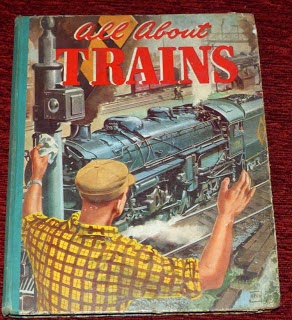
One of the earliest picture books I can recollect, was on trains.  When mother fed me morsels of food, I used to flip the pages of this thin book, which probably had just about a dozen pages.  I do not know if they had been reduced to few pages by my handling!  I had managed to salvage one page many years ago when I grew up.  But it too disappeared about 15-20 years ago.  It had full page attractive colour paintings of different railway engines and trains - in fact, they were photo-like paintings, so real and one of my favourites.  My search for it on the web gave me these two images - both from 1950s and my memory is from the 60s.  These look very similar to that.and I can never remember to have seen its cover page!

We used to play chuku-bhuku-chuku-bhuku slowly running, holding shirts of the boy in front while the leading boy was the engine. We had to run in such a way that our toes did not hit the heels of the boy in front.  The 'engine boy' mimicked the engine sound of chuku-bhuku and also the whistle sound of 'koooo... koo', with the webbing between the right thumb and index finger held to the lips.  The left arm mimicked the back and forth motion of the piston rod at its wheel.  That was a very popular game in those days. It had no meaning, except imitating the train and getting thrilled, just because the trains were that fascinating.   See this video:


Mimicry experts used to mimic the typical sound of the chugging steam engine and they still do it in the diesel engine era!!  The new generation will never understand its beauty!  It is an easy-to-do mimicry done the same way the 'engine boy' did and they do so beautifully.

Some movie songs also feature this fantastic rhythmic music of the steam engine, chuku-bhuku.

I still continue to do rail track watching even now!  It is a great pass-time on long journeys.  I could not help taking a video recently on the return trip from far away Dehra Dun! See:


People who were renown of telling untrue incidents or similar harmless stories would be nicknamed as "Railu" (ರೈಲು) meaning "Train", like my late maternal step uncle 'Gunda'.  He was so fond of getting kicks out of telling about incidents as if he was at the spot and many times he would have come up with a deviated version!  Such 'news' were 'train news' and we did not attach much value to them, because it was told by Gunda.  

Soon after my marriage, my wife, mother and late paternal aunt planned a trip to Nanjangud.  My older memories are in a separate post here. [Click].  I was the one who bought tickets at the Chamarajapuram Railway Station for the four of us.  If I remember right it was a sum of Rs.10/ I paid.  He gave me four tickets.  I was happy four persons would be traveling for just ten rupees!  It had been a long time since I had traveled to Nanjangud.  So I thought the Railways have not raised the fare by much.  We alighted at Nanjangud Town Rly. Station.  There was no rush but just a few passengers who had alighted.  We had to hand over the tickets at the gate to the Ticket Collector.  He stopped us and asked who traveled.  He saw the four of us together.  I was surprised why he was asking.  He took us to the Station Master and explained showing that we had traveled using 'Child Tickets' with half fare!!  I was completely taken aback and embarrassed.  I was completely unaware why and how I was handed over those 'child fare' tickets.  I explained it was honestly unintentional but he would not listen. The fine for this was double the fare.  Sheepishly, I paid and learnt a lesson.  The visit to the Temple was smooth our return journey by the next train 2 hours later was with the proper tickets.   

B.V.Pandit established his Ayurvedic Medicine Unit , 'Sadvaidyashala' in Nanjangud in 1913.  One of his products was the medicated tooth powder, pink, sweet and sold in paper packs.  It was very popular esp. among children notwithstanding yours truly, due to its unique flavour and edibility!  Even now it is available, but in aluminum foil packs.  Actually, I use it even now and try my own combos with different brands of tooth powders to good effect.  The beautiful 'Nanjangud toothpowder' was in so much demand that the Mysore-Nanjangud train was nicknamed as 'Toothpowder Express' and funnily, B.V.Pandit was nicknamed Baai Vaasnay Pandit [Foul-smelling mouth]!   ಬಾಯ್ ವಾಸ್ನೆ ಪಂಡಿತ್ !

The local transport unit also experimented what they called as "Road Trains". It was nothing but two buses.  The driverless hind bus was hooked behind the main bus - towing to be precise. They were in gray colour introduced in the early 70s.  It was discontinued as it faced problems while making road turns.

Small rails had to be joined together to make an oval track, a winding toy engine and a couple of little bogies behind it!  What a sight it was!  It never lasted beyond a few days and I had to be content in seeing superb solid mini models displayed in the Railway Stall of the Mysore Dasara Exhibition.

Friday, November 29, 2013

Memories of Nanjangud Temple sojourns

The 1000-year old Temple of Lord Srikanteshwara/Nanjundeshwara at the small town of Nanjangud, renown as the Benaras of the south, used to be visited by us almost like a periodic routine. It is 14 miles south of Mysore. We went by both road and rail.  Some of the fine memories of the several sojourns we undertook esp. in the 1960s remain etched in the memory.  Firstly let me recall the train journeys. 


On the left is a picture from 1865. The recent image is from 'skyscrapercity.com', appears to have been taken on a day when there are just a few people.

Many of the auspicious days on the lunar calendar were kept aside for visits to Nanjangud.  Our house was at Devaparthiva Road.  The vintage Chamarajapuram Station was just two furlongs away.  This little station was from the late 19th century and resembled something like what R.K.Laxman illustrated in his illustrious brother R.K.Narayan's grand novel "Malgudi Days".  The RKs also lived 5 furlongs away for some decades roughly from 1930.  Since actual photographs are not available, this serves as a visual as it is very close to how it looked.


And this is how it looks now almost from the same angle.  Track is broad gauge now. The old tiled building is also renovated adding new shelters for waiting passengers.  The huge concrete name board is a favourite of mine due to the letter type and its antiquity. 

[Image by author]

The early morning train suited us best.  If we were late to start, someone had to run to buy tickets to save time while the older ones reached gasping!  I was curious to look at how the ticket was issued.  The counter window at a corner had a wooden plank that was as high as my head and I had to crane my ncek to peep into the station master's room.  Methinks it was the station master himself who issued tickets and sometimes also struck the bell.  After money was handed, he would issue tickets only after he inserted tickets into a slot of a peculiar machine. In fact, I read that these machines were still in vogue and were withdrawn by Railways, only last year or so.  These cardboard tickets with destination, serial number and fare already printed.  That machine printed the date. Those neat tickets fitted my little palm and they became playthings after the journey.  

[Image from IndiaMike]

[Image from Wiki]

After buying tickets, we used to wait on the platform.   We kept an eye on when the level crossing gates were closed as it indicated the arrival of our train from the main station.  Opposite this station is Kannegowdana Koppal.  Crossing the dilapidated barricades parallel to the track some people from Koppal would wait with large vessels next to the metre guage track.  I used to wonder.  That was for collecting excess hot water, which the steam engine driver would release for them when it stopped.  They used that water for bathing or other things before it lost its heat.  That saved them the chore of boiling while also saving fuel.

Another amusing thing to watch was the exchange of the token ball.  http://www.indiamike.com/india-images/pictures/single-line-token-exchange-action   It was the safety measure for single tracks.  Read in the link what it was all about.  You will see in the picture there that the driver and the station staff are exchanging the ball - kept in the leather bag tied to that cane ring with a handle.  

At Chamarajapuram, when some goods train passed without stopping, he would drop that cane ring with ball before getting ready to receive another.  He would hold his arm stretched to 'catch' it. The ring clattered into his shoulder as the train kept moving.  This was another sight to watch.

When our train arrived we would all board it.  Soon there would be a bell, which was a 2-feet piece of a steel rail hung in front of the Station Master's room and stuck with a small iron object. The clangs from this could be heard even at home on silent mornings.  The Guard and the Driver communicated with the Station Master with flags.  At night they used kerosene lamps with a green or red tinted glass lens.  Even the level crossing had a kerosene lamp fitted to a pole. 

When the green flag was waved, the train's whistle would go....Kooooo.....koo.  Then Chuku bkuku chuku bhuku...the train would move.  I was also eager to see if the signal hand connected by a long steel cable many hundred feet away.  As our train moved, I used to follow the cable running parallel to the track up to the pole.  The lever in the Station Master's room was operated for this.  It was a great thrill to see the Station Master, just as much thrill to see a policeman on night beat, in flesh and blood!! 

It took about 45 minutes to reach Nanjangud, stopping at Ashokapuram, Tandavapura and Kadakola stations.  Nearing Nanjangud, the train [metre gauge] passed over a bridge built in the 1730s, yes, 1730s, on River Kabini.  It is the oldest bridge in India.  It had both rail and road running parallel, which is a unique feature.  Since it is dilapidated, traffic is suspended [since just a few years] after building separate bridges for road and rail with broad gauge.  On that old bridge, it was thrilling to watch from the train vehicles moving next to our train.  When we were in the taxi, if we were lucky, the train would be moving beside. I compared speeds.

Old bridge [now not used] where the rail and road run closely. Picture taken from our moving bus recently..

After alighting at Nanjangud Town Rly. Stn., we would walk down or take a Tonga [horse cart] and go through the Bazar Street to reach the Temple .  It was a lovely, calm and peaceful temple to visit, with stone pillars, stone floor, stone roof and a magnificent ambiance true to a really sacred place.   My grandmother would focus on the idol of the deity and do the praying while we followed suit. As soon as the rituals and mantra chanting were completed by the priest, we were back in the station to catch the train to Mysore, but not before relaxing for a few minutes.  My mother, younger brother and an aunt also accompanied on these mini pilgrimages. But when my grandfather came, we went by a taxi, owned by one Khallaq, an acquaintance of Salar Masood Sahib who was my grandfather's client.

We did several trips in Khallaq's black and cream taxi - may be it was a Hillman.  The number 77 painted on the doors on either side ever remains in my memory. Whenever and wherever we saw some other taxi, we would get excited 'Khallaq's taxi!'. There was a taxi stand behind Town Hall where a new structure has come up now [Makkaji Chowk] and Khallaq used to be there. So it was my grandfather who found him the previous day to fix up the next day's tour.  Very calm and soft-spoken driver, he was our favourite.  It was fun going in his taxi.

I tried to imitate my grandfather's style when he sat near the front window. He would rest his elbow on where the glass shutter went down and held the upper frame with his palm. When I tried, my arm was so small.  Now I can imitate. I do, when I sit in our car and recall those days!

Even now when I go on that stretch of road before reaching the old bridge [now a new parallel one is used], I recall a sight I saw when I was probably 2 or 3 years old.  It was this sight that has firmly stuck in memory.


River Kabini goes in a curve. At that time I am now recalling, there was a large amount of water, may be double than in that picture.  You know what I had exclaimed?  "Umba Neeya".... Actually it should have been "Thumba Neeru".  But I was not yet proficient in correct pronunciation at that small age.  This is so fresh in my memory that I can feel as if I'm watching that now, sitting on someone's lap, may be it was my mother.  There was an unobstructed view of the river. 

The most uncomfortable part was when my grandmother made a vow for me for a ritual called 'Tula Bhara' at that temple and a large quantity of jaggery cubes would be bought and taken.  For this, it was always in Khallaq's taxi.  There used to be a big weighing balance suspended in an open shed in the quadrangle.  It was meant for this ritual.  On one tray I would be made to sit. In the other, jaggery cubes, weighing equal or a wee bit more.  This jaggery was offered to the Deity.  Kings would do the same, but with gold coins instead of jaggery or whatever item that was vowed!  I was extremely shy to get weighed in front of so many people and this is what made me uncomfortable. I tried to shy away and got cranky.  I do not clearly recall if we took a bath in River Kabini close to the temple before going in, which many people used to do.

Sometimes we went on weekdays also. Without hurry, we were able to return well in time for my grandfather's 11a.m Court time.

Inside the stone temple, it was so cool.  I used to run here and there and my grandmother used to break the 'prasadam' coconut halves and offer us a few pieces while we relaxed before embarking on the return journey.  There used to be a rickety door [which was locked] to a small shrine full of bells.  Many children used to shake them to produce the clangs in different frequencies - cling, clang, tlong, long, plong, all would go in a chorus but the one that did not have the 'n' would stand out!!

Snapping fingers at the tiny idol of Chandikeshwara, the sight of the Mystery Bilwa Tree growing on the roof, a Shiva Linga on the Temple tower peeped through a ventilator, the peaceful open quadrangle, some huge brass 'Garuda', etc. used for the processions being stored in some free place, the oily aroma in the temple premise, all stand in memory.   There is a huge Sacred Stone Bull at the entrance.  This was the first mini temples we would be visiting in the premises.  A couple of bananas would be offered to the the Bull. The priest would peel it and place it at its mouth, horizontally.  It is an unforgettable sight on the seated black bull.  A mantra would be uttered and then he would give that banana as 'prasadam'.

The peaceful ambiance itself inside the vast temple premises used to take me to a blissful state, which I could not express at that time.  We could stand there any length of time and get energized being in such close proximity of the Deity.  There was no queue system or barricades to visit the sanctum sanctorum, like it has become necessary since about 15-20 years.  And there were so many other 'mini idols' that had to be worshipped/visited.

We traveled to Bangalore also many times and that is in a separate post.

Childhood memories are best. 

Train journeys of yore


Undertaking a train journey during my childhood was like an adventure.  Let me slowly trudge back to the bygone decades to 'nostalgiate'.  We traveled from Mysore to Bangalore occasionally, because of many relatives there.  Sometimes we took the bus also, but trains have that 'something' special.  We traveled to Bangalore for various purposes.  From our house we would take a tonga [autorickshaws in the 1960s and 70s were only a handful] to reach the Mysore Station [right] which was just over a mile and a half away.  


The journey of eighty seven miles took four hours.  I have no idea how much the fare was.  Mysore Railway Station had only one platform, which was vintage. I found an old picture that was shared in "Heritage Objects of Mysore" group on facebook. Here it is:


 My grandfather Subba Rao used to pack a lot of clothes even for a 3-day trip.    Two pants and two shirts separate for the onward and return journeys.  It was because, in next to no time the clothes got blackened in the train.  Seats were wooden planks, painted light yellow.

Before occupying the seats, we would wipe the seats with something.  Yet, we would find all portions of clothing coming in contact with the seat or anywhere, blackened.  'Black magic'!  It justified my grandfather who always wore light coloured clothing having a separate journey set.  But we were no exception either.

Tracks were metre-guage and the trains were pulled by coal-fired steam engines.  It is well known that burnt coal produces a lot of smoke. Fine particles of invisible coal ash would be all over the train, but 'black magic' was inevitable.

Traveling with my grandfather was exciting more because he was my favourite and also for his fascinating old-time stories that he 'nostalgiated'.  I used to ask for the window seat.

Glass window shutter and the rain/sun protection shutters were quite heavy and were held up with a crude stub.  The construction was quite crude and the bogies looked old too.  When the train rattled quickly, the vibrations would cause some loose shutters to slip down past the stub and fall with a thud.  Sometimes it fell for no reason too!  We used to hear incidents of passengers' hands getting injured by them esp. children. So we were advised to be careful not to keep the hand at the window base.  Those who were drowsy would wake up with a jerk when such a shutter fell suddenly!

When the wheels of the bogey passed over the rail joints there was the continuous tak-tak....... tak-tak sound throughout the journey.  It was so hypnotic that the sound kept ringing in the ears for quite a while, post journey.  We also felt as if the bodies were slightly swaying left to right.   These were the brief after-effects for a journey even this short.  Longer the train journey, longer these funny effects lingered.


Looking out of the window was a joy, but many times small cinders of coal flying out of the engine's chimney landed in the eyes.  "Do not rub the eyes." they would instruct. Someone would remove it from the finger-tip or blew hard into the eye to get rid of it.  When it was quite tiny, the corner of a folded handkerchief was the tool.  It dampened the joy of window-seat travel for the rest of the journey, because the eyes would become red and burned.  The thick black smoke spewing from the engine chimney added charm to the scenery.  Without smoke, like this, the picture would not be complete! At times there were red-hot cinders in large numbers 'whooshing' up as well.  When the wind took it away from my direction, I was happy.


I was very curious of going near the engine when we had time before boarding the train.  Feeling the heat radiating many feet was itself a small thrill.  The engine drivers, usually two, were blackened entirely and their skin shone due to sweating.  What a tough job I used to wonder. There were some clock-like meters that displayed something.  It was great to watch how they would use a huge spade to pick up coal from the huge container behind the engine and throw it into the oven. When the whistle was tested, the driver would pull some wire at the top..... my hairs would stand on end and was watching when the whistle blew 'koooo.....koo'!  Then some steam would escape from another outlet next to the engine chimney.  Great fun!

In recent years there was one popular man selling groundnuts [peanuts] on the train.  In the earlier days, vaguely I recall fruit vendors who hopped on at the stations on the way.  Coffee and tea were not sold on board in those days.

We have seen trucks and cars being pushed by people to get them into motion, but not trains.  Wait.  Hear this amusing real story of my grandfather fondly narrating how train passengers got down and pushed the slowing train up a steep gradient.  He would start his story as soon as the train picked up speed a couple of miles ahead, to gather the momentum required to cross the  upward gradient, going towards Bangalore. He knew from his journeys over many decades perhaps dating from the 1920s that we were nearing that gradient.  In fact when the broad gauge was made a few years ago, this gradient was taken care of.  It was somewhere near Ramanagara. In my grandfather's time when the engine's HP was lower, many times, he used to say the train stopped.  That is when the passengers got down and pushed it forward till it crossed the gradient!!


Whenever we got close to Srirangapatna, my grandmother was ready with a coin. She would give a coin to me also, for 'offering' it to River Goddess Cauvery [Kaveri].  We threw the coin out of the window to the river when the train was passing on the bridge over it.  It was fun following the trajectory of the flying coin till it touched the water, by which time, the train would have passed a long way. I also enjoyed the hollow sound the train made with the air as it passed on the bridge.  Took this picture recently when the train was on the bridge.


People used to carry water in glass bottles.  These bottles sometimes broke when it fell and made a dangerous mess with water and broken glass on the compartment floor.  Pre-plastic days, you see!

My grandmother used to carry her drinking water in a brass vessel with a handle.  There was a perfectly fitting brass cup underneath, placed at the neck. The handle-lid is screw type.   I cannot remember exactly the luggage she carried, but I vaguely recall that it was a sort of basket containing her saris.   My grandfather used to carry a kit bag or a suitcase.  In days still older, the only luggage was steel trunks of different sizes, which we now use as storage trunks. Imagine the days when they used to carry them for those journeys!

The train would stop at every station for a short while. Srirangapatna, Pandavapura, Mandya, Maddur, Channapatna, Ramanagara, Bidadi, Kengeri and then reach Bangalore.  Maddur Station was famous for its Maddur Vada and people would flock at the platform counter when the train stopped briefly.  But there are many instances of people having missed the train at Maddur while engrossed in eating! My grandfather's cousin Chandu was one.  This was another of my grandfather's stories.

Outside the Bangalore Railway Station we would look for an autorickshaw - they were in great numbers there.  We would ask him to take to "Tata Silk Farm", a famous landmark in Basavanagudi.  That was the southern end of Bangalore then.   We 'pitched tents' almost invariably in my aunt's house there.  Depending on the programme the return journey was either by train or by bus as buses were more frequent.  "Non-stop" buses [the board mentioned it] had become popular.

We also went to Nanjangud by train.  It is 'nostalgiated' in a separate post. 

Wednesday, September 25, 2013

Train journey travails

Lucknow was the place chosen for our annual cricket tournament in 2002, organized by the employer HQ. We had a good team, a mix of players from the 'branches' located at several places.  In the 16-member contingent, three of us were from our branch. Prior to the 3-day tournament, there was a 3-day practice. I chose to skip the practice part while my two younger team mates went ahead of me by 3 days. Traveling alone, I was to join the team just a day ahead of the match.

Mysore to Lucknow is more than 2000 kms. Lucknow is not connected by direct trains from Mysore. It takes two full days and a change of trains at Bangalore and Jhansi.  Long time gap during change overs is a difficult time esp. when alone.  Running with heavy luggage to reach the train, changing platforms, crossing footbridges and traveling itself is a tense and tiresome experience.  In the past, I have traveled alone and have faced many tense moments. But this particular journey had in store something very unexpected and freaky.

In Bangalore there was a two hour time gap for the next train I had even gone to my relative's house for a meal in Malleswaram, just ten minutes [by autorickshaw] from the Bangalore Railway Station.

Karnataka Express chugged off on time at 7.20pm.   I was to alight at Jhansi 32 hours [1700 kms] later for the second train-change over.  Half past three in the morning was the expected arrival time, a very odd time to be alighting.

I had the lower berth in the middle of the compartment where its night light was just like night! Most of the passengers had also switched off the lights. Dark.  All was well till I tried to sleep for the second night in the same place.  My luggage was chained to a ring underneath the seat.  I had to be awake when the train would arrive at Jhansi, well ahead as there would be no one to wake us up in case sleep got sound!


The mind was very restless.  What if I sleep through Jhansi, if sleep 'happened'?  When exactly will Jhansi be reached?  Was our train running on time? Whom to ask?  The TTE [Train Ticket Examiner] was unseen. These constant worries kept haunting.  Every few minutes I tried to see my black dial watch but could not see time as it was dark. I would wait for the train to pass through some station which had lights to catch that light on my watch to see time.

Half past mid night, then one, half past one, then two.  I had tried to see the watch a hundred times. How far was Jhansi?  I have known Jhansi to be a busy junction.

It was about 2 a.m when the train came to a halt.  It was some station I could not know.  Many people were shouting in such a way it told the short duration of this train-stoppage. I lay on my tummy, jacking up on my elbows to see through the glass window.  There was a huge sea of people in great hurry.
All of them were barging into all the 'reserved' compartment, including ours.  The number of seats/berths was 72/bogey, but within a few minutes there were 200 people including the sleeping 72. The TTE had vanished. These people occupied every available inch of space in the bogey. I am not exaggerating 'inch'. There were two people sitting on my berth and one had already occupied the leg space on the floor, sleeping.

The huge group appeared to be part of some political movement. I am sure they were all ticket-less. The train started to move again and I lay back to wait to see which station would come next. There was no halt for the next 40-50 minutes.

When the train slowed down and halted alongside another station that had a long platform, I got panicky.   The station appeared to be a large one, with lots of lights. If it was Jhansi, I had to get down now!!  I had to squeeze my way out through the people somehow. I asked someone if this was Jhansi. There was a 'Yes'. I panicked further.  I did not know how long the train was stopping here. I could not get a clue about the station name, anywhere.

In this state of mind, I unlocked my luggage chain, pushing the sleeping fellow on the floor and pulled up my suitcase. There was no space for my feet to land on the floor!  Since I was in the middle portion of the bogey, I had to reach the end for the exit. But the aisle was completely jam-packed. Many were highly drowsy in standing position.  The snorers were not one bit affected by this hullabaloo.

I had left my seat/berth pushing my suitcase in between jam-packed people and I was feeling for my foot to land.  Where the suitcase went, I had to follow.  My kit bag tugged across my shoulder followed me.   It was inevitable that I had to land on one or two sleeping people, with just a mental excuse.

Some people had switched on the main lights of the compartments now.  As soon as I left my berth, three people squeezed in to occupy it, crouching because of the middle berth. If the train moved now I'm a goner, I thought.

I had squeezed my way through these people and with just a short distance from the exit, someone asked me which station I was to get down.  "Jhansi" I said.  "But Jhansi is still one hour away, this is ...x.... station!" Someone had misled me, probably to occupy my berth!

Now there was no way I could return to my berth, just a few feet behind me!!  People in the bogey were like a box full of worms.  At that spot I could see two people fully awake in their berths.  One of them was a young lady watching all this commotion and my confusion. She was in the middle berth nearest to where I was 'trapped'.

On the lower berth, there were two each sitting on opposite seats as the original berth-holder was sleeping. There was one sleeping on the floor.  My left leg was between two people sitting in the aisle and my right had found a place.  If I had slippers, they would have been lost. But I had shoes. The suitcase had found a few inches on the edge of the seat. My left hand trying to get a hold, kit bag hung in front of me.  They pack sheep in trucks more loosely.  Imagine the scene!!  There was no way I could stand one hour here with my luggage.

The only space available was on that young lady's berth. She was leaning her back to the window-side 'wall' and so there was half berth luckily unoccupied by anyone from that group.  There were people near the exit, in front of the toilet door and even in the vestibule.

The young lady readily and understandingly agreed to my request to occupy the half berth.  I thanked her. I now had space for my suitcase and the long legs which had to be kept on the opposite middle berth!  I had to manage sitting in a curved position.  The young lady was reading the Holy Bible and also seemed to be praying in between pauses. She did this for a long time.

A few minutes seemed like an hour. There were no further halts or stations for quite a while as the train hurtled fast as if to gain lost time.  I managed to get a few winks of sleep in the posture I was. The kit bag served as a resting aid for my arms.

"Jhansi".  I heard someone call out when the train slowed down.  The train came to a halt.  Since I was higher than the window I could not see anything.  And IT WAS Jhansi.  Announcing "Jhansi aa gaya, uthro" a few passengers were preparing to alight squeezing their way through those people. I thanked the young lady profusely and got down from the berth.  People near the door had got down to free their lungs and arms!  Finally, some 'space'!  What a relief it was to get out of this compartment!  At last, I set foot on the platform, as if I was landing on the moon!  I learnt that the train was indeed late by about 40 minutes.  It was now past 4 am.

How I wished I was like the Friendly Ghost Casper to walk through doors and walls and people!


Lucknow was still 4 hours and 300 kms away from here.  The next train was at 8 am which meant four more hours - of waiting, alone.  So I went to the resting lounge where many such 'waiters' were snoring, some on chairs and some on the floor, with luggage secured by chains.  I too occupied a chair and tied my luggage like a dog.  Luggage thieving is rampant and so the passengers have to be on the vigil.

When the sun rose and a telephone booth opened near the resting lounge, I called the organizing secretary at Lucknow that I would be arriving at about 12.30 pm and requested for transport for my pick up to join my team at the quarters. All was fine.

We lost our first match in a nail biting finish in the last over.  My personal contribution of 76 in 66 balls in a low scoring match seemed to have turned the game in our favour but not to be. Pitambar Dutt's 70 took the game from us. Since it was a knock-out tie, our team had no further role.

The purpose of our 40+ hours journey had ended in a mere four hours.  It was ridiculous!  But some of us made use of the free time to see the historical city.

Return journey was smooth and we threesome now traveled together with an unhappy feeling of having lost our first match.

Here are some images that float around the web. This is outside the train.  Expect the same inside!


The same year 2002, Indian Railways was 150 years old!


=====================================

Wednesday, September 11, 2013

Train boarding cliff-hanger

In 2007, our official biennial cricket tournament was in Chandigarh.  It was a long travel of 2 days from Mysore by train. Other team members had left a day before.  My team mate Shivu was to accompany me on the travel.  We were to board the train leaving at 9.10 pm to New Delhi at Yeshwanthpur, some way away from the main Bangalore Railway Station.  

Since there was no suitable train in the evening from here, we chose the road journey to reach Bangalore as buses were available every 5 minutes.  About three to three and half hours would be this journey. So we decided to start at 4 pm. If all went well, we would be there by 8 pm, more than one hour ahead of the departure.  

When I reached the bus station on time, Shivu was NOT around the spot we had agreed to meet.  Half past four, no Shivu.  Five, still no Shivu.  Now I started searching for him in all the moving bus windows as bus after bus were snailing out of the station.  Quarter past five, it was status quo.  My train tickets were also safely with him!!  

"I was here", waiting.  Buses were choc-a-bloc that evening and not as thin as it looks in this old Google image. [Click to enlarge].


Strange thoughts crossed the mind several times because this Shivu had a reputation of being careless. Suddenly there came the familiar voice from a bus window, Shivu calling my name in a tone of relief!  It had been almost 80 minutes since I stood there. He had a seat next to him.  I had to believe when he said he was searching for me all the while before he decided to board that bus!  

This was another instance where a mobile in my pocket would have solved the issue!  See my other blogpost where I have had to face yet another small confusion. [Click]. 

The bus was moving.  Half past five and now just three and half hours left for our train.  When the conductor came to issue us tickets we anxiously told our plight. He reassured us that we would reach by half past eight.

From Bangalore, Yeshwanthpur Rly.Stn was some distance away which meant some more precious minutes! Bangalore is notorious for its traffic jams.  It was half past eight and 'on time' and had "almost reached" the destination. 'Almost' because we had reached the deadliest, narrowest bottlenecks leading to the Bangalore Bus Station. 

Look for TCM Royan Rd. towards the left in this screen capture of the map. Look for 'Jam'.  This was about where we were jammed! 


Traffic in this dense jam was inching its way so slowly that it would have taken half an hour to get out past the traffic signal. We were at the half way point and we noticed that smaller vehicles were moving ahead more easily.  We now had 25 minutes left for the train departure.  Each second would count for us from now on.  Any delay meant we had to return home because it was a long distance travel and our team would have suffered a shortage of players. 

Just at that time, we saw an empty autorickshaw stop right next to the foot board.  Since traffic had stopped and there was some 'road space' to get down, we decided to hop on to the autorickshaw.  He had agreed to take us to Yeshwanthpur Rly. Station after we explained our urgency.  We soon agreed to his fare when he assured he would take us there in 15 minutes at the most, through a shortcut.  Luckily, the smaller vehicles were escaping quickly and more easily from the side and there were tens of them ahead of us.  Very soon, we were out of this jam.

I cannot count the number of times I looked at my watch that evening.  True to his words, he took us in 15 minutes flat.  Now, ten minutes left when he left us beside the station in a by lane. We thanked him profusely.  Every nano second would count now.  We had to cross the road and walk, nay run, some distance [with luggage] to get into the Station.  Eight minutes to go. We briskly crossed the road, already perspiring.  From where we crossed the road, we saw the tail of a train.  The station gate was many metres away to the left.

I tried to visualize that scene on paper now.  Remember it was 9 pm and dark. This is what we saw before we crossed the road:


There was a compound wall which was slightly taller than my shoulder that looked surmountable and the nearest route for us to be 'on some platform'!  Much younger Shivu climbed first after keeping the luggage on the wall.  We climbed the high wall like thieves escaping to safety.  I had to pull myself up, holding the edge of the wall, right leg first up, stomach scraping the top of the wall, sitting, jumping down, picking up luggage and running for the train.  Which train, where was our train?  Time, 3 minutes left.  

We dreaded the fact of searching and running to another platform or crossing tracks. But to our luck, the train we had seen was ours!   The board displayed on the bogey showed it!  This was about 40 feet from the compound wall we had just jump-crossed. To add to our luck, even our compartment was right there, in front of us, may be the third or fourth from the last!!  And we need not run anymore at all!  What a relief!  No sooner had we settled our luggage beneath our seats, we felt the jerk.  The train was moving. The time was 9.10.  We had made it!  Call what you may, cliff-hanger, filmy style. 

We had spilled all the 'cushion time' in Mysore itself.  This post need not have been written if I had a simple mobile phone and established contact with Shivu.  Ha, now suddenly I recall that I had attempted to contact him from the public booth nearby at half past four but "switched off" was the message.  What to do?

 The tournament from our team's perspective turned out to be one not to remember.

*************

Let me tell another 1994 story in brief.  
Our club cricket team had gone to Kumbakonam.  I was to join the team 3 days later for further matches.  Mohan Ram was accompanying me in the bus journey which was about 12 hours total time.  We expected to be well ahead early morning for our match at 8 am. We had started at 4pm. On the last stretch, the next morning as we closed in to the destination, some farmers' agitation had blocked traffic for 2 hours.  I remember we brushed our teeth during the blockage, beside the road. When we landed at our hotel, it was quarter to 8 and when we rushed to the ground after dumping the luggage and quickly changing to our cricket gear, our captain had made the toss and we were to take the field.  I played almost right off the bus...the engine sound still ringing after the overnight journey by ordinary seat.  We won the match and eventually after two more matches in the next two days, we ended runner-up.

****

Monday, December 3, 2012

A chance sighting in the crowd

I was eleven when my father planned a trip to Bombay and he was taking the family of four.  Bombay was where my father had great memories and experiences in his work as a 'Sound Engineer' for the Films Division.  He would often reminisce and describe instances, the hardships, rains, local trains, busy life and so on.  He never got tired of them.  He never wanted to move back to Mysore because of the professional opportunities.   Only his mother's pressure to return, get married and stay with them brought him back, very much against his own liking. So eleven years later, in 1969, he wanted to return to relive some fond memories of Bombay.

We set about this train journey to Bombay from Mysore.  It was to be long and tedious.  Sleeping on upper berths was a thrill.  Ropes had to be tied to prevent us from falling down from the berth. Seats and berths were only wooden planks and we had to carry our bedding to be able to sleep.  It was a lot of luggage of four people.

We had to change trains at Arsikere, Miraj and again at Poona [now Pune] and we would reach Bombay on the third day!  Nowadays, a direct train to Bombay [renamed Mumbai] takes us in 24  hours.

At Arsikere, we had to wait 4 hours and catch another coal engine train to Miraj.  Then at Miraj, I think our bogey from that train was detached and re-attached to another train that went to Poona.  Then at Poona, it was electric train.  The route was magnificent and we got the thrill of traveling in numerous long tunnels along the hill route.  Two engines pulling our train was an incredible sight for me.

Now let me come to the subject of this post.

At Mysore Station, before we boarded the train, we had met a few members from the Somayaji family that lived in our locality. His daughter and son-in-law with their families with two kids were in Bombay and were returning after a vacation. Somayaji's son and his family was accompanying them on the journey.  They were also traveling by the same trains.  Since they knew us quite well, they affectionately invited us to stay with them in their apartment in Bombay and they really meant it.  We soon boarded in different compartments and we could not meet again in the journey. We alighted.at Dadar Railway Station which was one stop before Bombay [Victoria Terminus].  It was about 8 in the evening.  

I cannot remember if the train was late.  There were a large number of people outside the station looking to hire conveyances. My father was wondering where to go and stay.  He had a few open options in mind.  But since it was so late, he seemed to get worried about his prepared options.  We had forgotten about the kind invitation made by the Somayaji family.  At this time, I could locate them nearby in the sea of people.  I showed my father 'there they are'.  When he went up to them and explained about his options, they just wanted to dismiss all that but to go with them!!  What a wonderful gesture! 

Horse-driven carts were hired to reach their apartment.  It was not far from Dadar.  Actually it was a 'flat' given by that person's employer and was very very spacious, located in nearby King's Circle.  The next 3-4 days, we had a great fun time, playing various games and running around the house along with the children of that house who had also traveled in the train. They were so leisurely and enjoying school holidays, that December. 

King's Circle was a landmark in Matunga.  It has now been renamed as Maheshwari Udyan.  Matunga was a very familiar place to my father as he used to live at Mysore Association [which is still thriving!]!  What more could he ask?  An ad balloon in that area was an attraction to us and visible from a long distance. We were seeing such a thing for the first time.  When we returned from our sojourns we used to frequently look at it as a sort of guide.

My father took us to a few places, mostly a few relatives's houses.  One Rama Rao who was with Crompton Greaves lived in his apartment overlooking the Arabian Sea and the Marine Drive, the famous spot.  He had also taken us to 'Malabar Hill/Hanging Gardens' from where Marine Drive could be seen at night, like a "Queen's Necklace".  I remember we had gone to Sion to another relative who had given this little toy/model truck. 


We had a taste of how fast life in Bombay was, even in 1969, esp. on local trains. I could compare the increase in density of people when I visited on my own in 1983.  Plastic items were new at that time and so we bought quite a lot of them. Some are with us even today.  We had been to the Bombay Dyeing showroom because an uncle was in that famous company.  A few towels we bought lasted a long time.  He also took us to his favourite Mysore Association.

We had not seen such fast moving vehicles on roads, that were beautiful too.  Such a one nearly hit my little brother when he tried to cross the road.  

The trip satisfied my father and probably it was the only time he took us together on a tour and it was to be his final visit to that place. It was a really memorable trip to all of us. We thanked the family profusely for hosting us, including our meals. 

If I had not spotted that family in the crowd, I cannot imagine how the tour could have gone.