Tuesday, December 3, 2013

Random Trainy memories

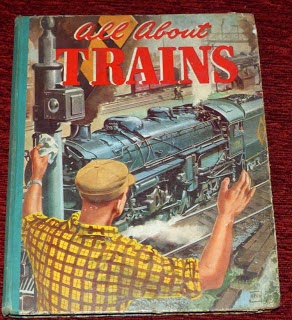
One of the earliest picture books I can recollect, was on trains.  When mother fed me morsels of food, I used to flip the pages of this thin book, which probably had just about a dozen pages.  I do not know if they had been reduced to few pages by my handling!  I had managed to salvage one page many years ago when I grew up.  But it too disappeared about 15-20 years ago.  It had full page attractive colour paintings of different railway engines and trains - in fact, they were photo-like paintings, so real and one of my favourites.  My search for it on the web gave me these two images - both from 1950s and my memory is from the 60s.  These look very similar to that.and I can never remember to have seen its cover page!

We used to play chuku-bhuku-chuku-bhuku slowly running, holding shirts of the boy in front while the leading boy was the engine. We had to run in such a way that our toes did not hit the heels of the boy in front.  The 'engine boy' mimicked the engine sound of chuku-bhuku and also the whistle sound of 'koooo... koo', with the webbing between the right thumb and index finger held to the lips.  The left arm mimicked the back and forth motion of the piston rod at its wheel.  That was a very popular game in those days. It had no meaning, except imitating the train and getting thrilled, just because the trains were that fascinating.   See this video:


Mimicry experts used to mimic the typical sound of the chugging steam engine and they still do it in the diesel engine era!!  The new generation will never understand its beauty!  It is an easy-to-do mimicry done the same way the 'engine boy' did and they do so beautifully.

Some movie songs also feature this fantastic rhythmic music of the steam engine, chuku-bhuku.

I still continue to do rail track watching even now!  It is a great pass-time on long journeys.  I could not help taking a video recently on the return trip from far away Dehra Dun! See:


People who were renown of telling untrue incidents or similar harmless stories would be nicknamed as "Railu" (ರೈಲು) meaning "Train", like my late maternal step uncle 'Gunda'.  He was so fond of getting kicks out of telling about incidents as if he was at the spot and many times he would have come up with a deviated version!  Such 'news' were 'train news' and we did not attach much value to them, because it was told by Gunda.  

Soon after my marriage, my wife, mother and late paternal aunt planned a trip to Nanjangud.  My older memories are in a separate post here. [Click].  I was the one who bought tickets at the Chamarajapuram Railway Station for the four of us.  If I remember right it was a sum of Rs.10/ I paid.  He gave me four tickets.  I was happy four persons would be traveling for just ten rupees!  It had been a long time since I had traveled to Nanjangud.  So I thought the Railways have not raised the fare by much.  We alighted at Nanjangud Town Rly. Station.  There was no rush but just a few passengers who had alighted.  We had to hand over the tickets at the gate to the Ticket Collector.  He stopped us and asked who traveled.  He saw the four of us together.  I was surprised why he was asking.  He took us to the Station Master and explained showing that we had traveled using 'Child Tickets' with half fare!!  I was completely taken aback and embarrassed.  I was completely unaware why and how I was handed over those 'child fare' tickets.  I explained it was honestly unintentional but he would not listen. The fine for this was double the fare.  Sheepishly, I paid and learnt a lesson.  The visit to the Temple was smooth our return journey by the next train 2 hours later was with the proper tickets.   

B.V.Pandit established his Ayurvedic Medicine Unit , 'Sadvaidyashala' in Nanjangud in 1913.  One of his products was the medicated tooth powder, pink, sweet and sold in paper packs.  It was very popular esp. among children notwithstanding yours truly, due to its unique flavour and edibility!  Even now it is available, but in aluminum foil packs.  Actually, I use it even now and try my own combos with different brands of tooth powders to good effect.  The beautiful 'Nanjangud toothpowder' was in so much demand that the Mysore-Nanjangud train was nicknamed as 'Toothpowder Express' and funnily, B.V.Pandit was nicknamed Baai Vaasnay Pandit [Foul-smelling mouth]!   ಬಾಯ್ ವಾಸ್ನೆ ಪಂಡಿತ್ !

The local transport unit also experimented what they called as "Road Trains". It was nothing but two buses.  The driverless hind bus was hooked behind the main bus - towing to be precise. They were in gray colour introduced in the early 70s.  It was discontinued as it faced problems while making road turns.

Small rails had to be joined together to make an oval track, a winding toy engine and a couple of little bogies behind it!  What a sight it was!  It never lasted beyond a few days and I had to be content in seeing superb solid mini models displayed in the Railway Stall of the Mysore Dasara Exhibition.

Friday, November 29, 2013

Memories of Nanjangud Temple sojourns

The 1000-year old Temple of Lord Srikanteshwara/Nanjundeshwara at the small town of Nanjangud, renown as the Benaras of the south, used to be visited by us almost like a periodic routine. It is 14 miles south of Mysore. We went by both road and rail.  Some of the fine memories of the several sojourns we undertook esp. in the 1960s remain etched in the memory.  Firstly let me recall the train journeys. 


On the left is a picture from 1865. The recent image is from 'skyscrapercity.com', appears to have been taken on a day when there are just a few people.

Many of the auspicious days on the lunar calendar were kept aside for visits to Nanjangud.  Our house was at Devaparthiva Road.  The vintage Chamarajapuram Station was just two furlongs away.  This little station was from the late 19th century and resembled something like what R.K.Laxman illustrated in his illustrious brother R.K.Narayan's grand novel "Malgudi Days".  The RKs also lived 5 furlongs away for some decades roughly from 1930.  Since actual photographs are not available, this serves as a visual as it is very close to how it looked.


And this is how it looks now almost from the same angle.  Track is broad gauge now. The old tiled building is also renovated adding new shelters for waiting passengers.  The huge concrete name board is a favourite of mine due to the letter type and its antiquity. 

[Image by author]

The early morning train suited us best.  If we were late to start, someone had to run to buy tickets to save time while the older ones reached gasping!  I was curious to look at how the ticket was issued.  The counter window at a corner had a wooden plank that was as high as my head and I had to crane my ncek to peep into the station master's room.  Methinks it was the station master himself who issued tickets and sometimes also struck the bell.  After money was handed, he would issue tickets only after he inserted tickets into a slot of a peculiar machine. In fact, I read that these machines were still in vogue and were withdrawn by Railways, only last year or so.  These cardboard tickets with destination, serial number and fare already printed.  That machine printed the date. Those neat tickets fitted my little palm and they became playthings after the journey.  

[Image from IndiaMike]

[Image from Wiki]

After buying tickets, we used to wait on the platform.   We kept an eye on when the level crossing gates were closed as it indicated the arrival of our train from the main station.  Opposite this station is Kannegowdana Koppal.  Crossing the dilapidated barricades parallel to the track some people from Koppal would wait with large vessels next to the metre guage track.  I used to wonder.  That was for collecting excess hot water, which the steam engine driver would release for them when it stopped.  They used that water for bathing or other things before it lost its heat.  That saved them the chore of boiling while also saving fuel.

Another amusing thing to watch was the exchange of the token ball.  http://www.indiamike.com/india-images/pictures/single-line-token-exchange-action   It was the safety measure for single tracks.  Read in the link what it was all about.  You will see in the picture there that the driver and the station staff are exchanging the ball - kept in the leather bag tied to that cane ring with a handle.  

At Chamarajapuram, when some goods train passed without stopping, he would drop that cane ring with ball before getting ready to receive another.  He would hold his arm stretched to 'catch' it. The ring clattered into his shoulder as the train kept moving.  This was another sight to watch.

When our train arrived we would all board it.  Soon there would be a bell, which was a 2-feet piece of a steel rail hung in front of the Station Master's room and stuck with a small iron object. The clangs from this could be heard even at home on silent mornings.  The Guard and the Driver communicated with the Station Master with flags.  At night they used kerosene lamps with a green or red tinted glass lens.  Even the level crossing had a kerosene lamp fitted to a pole. 

When the green flag was waved, the train's whistle would go....Kooooo.....koo.  Then Chuku bkuku chuku bhuku...the train would move.  I was also eager to see if the signal hand connected by a long steel cable many hundred feet away.  As our train moved, I used to follow the cable running parallel to the track up to the pole.  The lever in the Station Master's room was operated for this.  It was a great thrill to see the Station Master, just as much thrill to see a policeman on night beat, in flesh and blood!! 

It took about 45 minutes to reach Nanjangud, stopping at Ashokapuram, Tandavapura and Kadakola stations.  Nearing Nanjangud, the train [metre gauge] passed over a bridge built in the 1730s, yes, 1730s, on River Kabini.  It is the oldest bridge in India.  It had both rail and road running parallel, which is a unique feature.  Since it is dilapidated, traffic is suspended [since just a few years] after building separate bridges for road and rail with broad gauge.  On that old bridge, it was thrilling to watch from the train vehicles moving next to our train.  When we were in the taxi, if we were lucky, the train would be moving beside. I compared speeds.

Old bridge [now not used] where the rail and road run closely. Picture taken from our moving bus recently..

After alighting at Nanjangud Town Rly. Stn., we would walk down or take a Tonga [horse cart] and go through the Bazar Street to reach the Temple .  It was a lovely, calm and peaceful temple to visit, with stone pillars, stone floor, stone roof and a magnificent ambiance true to a really sacred place.   My grandmother would focus on the idol of the deity and do the praying while we followed suit. As soon as the rituals and mantra chanting were completed by the priest, we were back in the station to catch the train to Mysore, but not before relaxing for a few minutes.  My mother, younger brother and an aunt also accompanied on these mini pilgrimages. But when my grandfather came, we went by a taxi, owned by one Khallaq, an acquaintance of Salar Masood Sahib who was my grandfather's client.

We did several trips in Khallaq's black and cream taxi - may be it was a Hillman.  The number 77 painted on the doors on either side ever remains in my memory. Whenever and wherever we saw some other taxi, we would get excited 'Khallaq's taxi!'. There was a taxi stand behind Town Hall where a new structure has come up now [Makkaji Chowk] and Khallaq used to be there. So it was my grandfather who found him the previous day to fix up the next day's tour.  Very calm and soft-spoken driver, he was our favourite.  It was fun going in his taxi.

I tried to imitate my grandfather's style when he sat near the front window. He would rest his elbow on where the glass shutter went down and held the upper frame with his palm. When I tried, my arm was so small.  Now I can imitate. I do, when I sit in our car and recall those days!

Even now when I go on that stretch of road before reaching the old bridge [now a new parallel one is used], I recall a sight I saw when I was probably 2 or 3 years old.  It was this sight that has firmly stuck in memory.


River Kabini goes in a curve. At that time I am now recalling, there was a large amount of water, may be double than in that picture.  You know what I had exclaimed?  "Umba Neeya".... Actually it should have been "Thumba Neeru".  But I was not yet proficient in correct pronunciation at that small age.  This is so fresh in my memory that I can feel as if I'm watching that now, sitting on someone's lap, may be it was my mother.  There was an unobstructed view of the river. 

The most uncomfortable part was when my grandmother made a vow for me for a ritual called 'Tula Bhara' at that temple and a large quantity of jaggery cubes would be bought and taken.  For this, it was always in Khallaq's taxi.  There used to be a big weighing balance suspended in an open shed in the quadrangle.  It was meant for this ritual.  On one tray I would be made to sit. In the other, jaggery cubes, weighing equal or a wee bit more.  This jaggery was offered to the Deity.  Kings would do the same, but with gold coins instead of jaggery or whatever item that was vowed!  I was extremely shy to get weighed in front of so many people and this is what made me uncomfortable. I tried to shy away and got cranky.  I do not clearly recall if we took a bath in River Kabini close to the temple before going in, which many people used to do.

Sometimes we went on weekdays also. Without hurry, we were able to return well in time for my grandfather's 11a.m Court time.

Inside the stone temple, it was so cool.  I used to run here and there and my grandmother used to break the 'prasadam' coconut halves and offer us a few pieces while we relaxed before embarking on the return journey.  There used to be a rickety door [which was locked] to a small shrine full of bells.  Many children used to shake them to produce the clangs in different frequencies - cling, clang, tlong, long, plong, all would go in a chorus but the one that did not have the 'n' would stand out!!

Snapping fingers at the tiny idol of Chandikeshwara, the sight of the Mystery Bilwa Tree growing on the roof, a Shiva Linga on the Temple tower peeped through a ventilator, the peaceful open quadrangle, some huge brass 'Garuda', etc. used for the processions being stored in some free place, the oily aroma in the temple premise, all stand in memory.   There is a huge Sacred Stone Bull at the entrance.  This was the first mini temples we would be visiting in the premises.  A couple of bananas would be offered to the the Bull. The priest would peel it and place it at its mouth, horizontally.  It is an unforgettable sight on the seated black bull.  A mantra would be uttered and then he would give that banana as 'prasadam'.

The peaceful ambiance itself inside the vast temple premises used to take me to a blissful state, which I could not express at that time.  We could stand there any length of time and get energized being in such close proximity of the Deity.  There was no queue system or barricades to visit the sanctum sanctorum, like it has become necessary since about 15-20 years.  And there were so many other 'mini idols' that had to be worshipped/visited.

We traveled to Bangalore also many times and that is in a separate post.

Childhood memories are best. 

Train journeys of yore


Undertaking a train journey during my childhood was like an adventure.  Let me slowly trudge back to the bygone decades to 'nostalgiate'.  We traveled from Mysore to Bangalore occasionally, because of many relatives there.  Sometimes we took the bus also, but trains have that 'something' special.  We traveled to Bangalore for various purposes.  From our house we would take a tonga [autorickshaws in the 1960s and 70s were only a handful] to reach the Mysore Station [right] which was just over a mile and a half away.  


The journey of eighty seven miles took four hours.  I have no idea how much the fare was.  Mysore Railway Station had only one platform, which was vintage. I found an old picture that was shared in "Heritage Objects of Mysore" group on facebook. Here it is:


 My grandfather Subba Rao used to pack a lot of clothes even for a 3-day trip.    Two pants and two shirts separate for the onward and return journeys.  It was because, in next to no time the clothes got blackened in the train.  Seats were wooden planks, painted light yellow.

Before occupying the seats, we would wipe the seats with something.  Yet, we would find all portions of clothing coming in contact with the seat or anywhere, blackened.  'Black magic'!  It justified my grandfather who always wore light coloured clothing having a separate journey set.  But we were no exception either.

Tracks were metre-guage and the trains were pulled by coal-fired steam engines.  It is well known that burnt coal produces a lot of smoke. Fine particles of invisible coal ash would be all over the train, but 'black magic' was inevitable.

Traveling with my grandfather was exciting more because he was my favourite and also for his fascinating old-time stories that he 'nostalgiated'.  I used to ask for the window seat.

Glass window shutter and the rain/sun protection shutters were quite heavy and were held up with a crude stub.  The construction was quite crude and the bogies looked old too.  When the train rattled quickly, the vibrations would cause some loose shutters to slip down past the stub and fall with a thud.  Sometimes it fell for no reason too!  We used to hear incidents of passengers' hands getting injured by them esp. children. So we were advised to be careful not to keep the hand at the window base.  Those who were drowsy would wake up with a jerk when such a shutter fell suddenly!

When the wheels of the bogey passed over the rail joints there was the continuous tak-tak....... tak-tak sound throughout the journey.  It was so hypnotic that the sound kept ringing in the ears for quite a while, post journey.  We also felt as if the bodies were slightly swaying left to right.   These were the brief after-effects for a journey even this short.  Longer the train journey, longer these funny effects lingered.


Looking out of the window was a joy, but many times small cinders of coal flying out of the engine's chimney landed in the eyes.  "Do not rub the eyes." they would instruct. Someone would remove it from the finger-tip or blew hard into the eye to get rid of it.  When it was quite tiny, the corner of a folded handkerchief was the tool.  It dampened the joy of window-seat travel for the rest of the journey, because the eyes would become red and burned.  The thick black smoke spewing from the engine chimney added charm to the scenery.  Without smoke, like this, the picture would not be complete! At times there were red-hot cinders in large numbers 'whooshing' up as well.  When the wind took it away from my direction, I was happy.


I was very curious of going near the engine when we had time before boarding the train.  Feeling the heat radiating many feet was itself a small thrill.  The engine drivers, usually two, were blackened entirely and their skin shone due to sweating.  What a tough job I used to wonder. There were some clock-like meters that displayed something.  It was great to watch how they would use a huge spade to pick up coal from the huge container behind the engine and throw it into the oven. When the whistle was tested, the driver would pull some wire at the top..... my hairs would stand on end and was watching when the whistle blew 'koooo.....koo'!  Then some steam would escape from another outlet next to the engine chimney.  Great fun!

In recent years there was one popular man selling groundnuts [peanuts] on the train.  In the earlier days, vaguely I recall fruit vendors who hopped on at the stations on the way.  Coffee and tea were not sold on board in those days.

We have seen trucks and cars being pushed by people to get them into motion, but not trains.  Wait.  Hear this amusing real story of my grandfather fondly narrating how train passengers got down and pushed the slowing train up a steep gradient.  He would start his story as soon as the train picked up speed a couple of miles ahead, to gather the momentum required to cross the  upward gradient, going towards Bangalore. He knew from his journeys over many decades perhaps dating from the 1920s that we were nearing that gradient.  In fact when the broad gauge was made a few years ago, this gradient was taken care of.  It was somewhere near Ramanagara. In my grandfather's time when the engine's HP was lower, many times, he used to say the train stopped.  That is when the passengers got down and pushed it forward till it crossed the gradient!!


Whenever we got close to Srirangapatna, my grandmother was ready with a coin. She would give a coin to me also, for 'offering' it to River Goddess Cauvery [Kaveri].  We threw the coin out of the window to the river when the train was passing on the bridge over it.  It was fun following the trajectory of the flying coin till it touched the water, by which time, the train would have passed a long way. I also enjoyed the hollow sound the train made with the air as it passed on the bridge.  Took this picture recently when the train was on the bridge.


People used to carry water in glass bottles.  These bottles sometimes broke when it fell and made a dangerous mess with water and broken glass on the compartment floor.  Pre-plastic days, you see!

My grandmother used to carry her drinking water in a brass vessel with a handle.  There was a perfectly fitting brass cup underneath, placed at the neck. The handle-lid is screw type.   I cannot remember exactly the luggage she carried, but I vaguely recall that it was a sort of basket containing her saris.   My grandfather used to carry a kit bag or a suitcase.  In days still older, the only luggage was steel trunks of different sizes, which we now use as storage trunks. Imagine the days when they used to carry them for those journeys!

The train would stop at every station for a short while. Srirangapatna, Pandavapura, Mandya, Maddur, Channapatna, Ramanagara, Bidadi, Kengeri and then reach Bangalore.  Maddur Station was famous for its Maddur Vada and people would flock at the platform counter when the train stopped briefly.  But there are many instances of people having missed the train at Maddur while engrossed in eating! My grandfather's cousin Chandu was one.  This was another of my grandfather's stories.

Outside the Bangalore Railway Station we would look for an autorickshaw - they were in great numbers there.  We would ask him to take to "Tata Silk Farm", a famous landmark in Basavanagudi.  That was the southern end of Bangalore then.   We 'pitched tents' almost invariably in my aunt's house there.  Depending on the programme the return journey was either by train or by bus as buses were more frequent.  "Non-stop" buses [the board mentioned it] had become popular.

We also went to Nanjangud by train.  It is 'nostalgiated' in a separate post. 

Monday, November 18, 2013

Beauty of Setting Full Moon

Last evening was full moon.  The bright and full moon at its pinnacle shone brightly around 11pm and made me compare it with a cool light in the room.   A clear sky and a full disc of moon is a treat to the eyes.

 It was quarter past 5 in the morning when the bladder woke me up.  The eyes opened and the sight of  the moon through the room window floored me.  I had not gone for my morning walk for the past 5-6 weeks.  The moon wanted me to get up and go NOW.  That was the moon's call, so was nature's. 

 Very soon, I was scootering my way to the University Athletic Ground, just a mile away.  When this ground is moonlit like this, it is idyllic, with the grand Crawford Hall as a backdrop.  We get the opportunity to enjoy such a setting esp. in the winter months between November and February/March due to generally clear skies.  Though there will be mist on many occasions, it can be a truly remarkable setting.  I took my little Lumix to capture it.  

Click on pictures to get a magnified view.  I have mentioned time at the bottom of each picture.


That was as soon as I began the 'morning walk'.  I used the backrest of a sitting bench for resting the camera on for shooting these.  Last year, sans the camera, I sat there on that bench and kept gazing at the moon for a long time till I remembered I had gone for a walk!  The moon was the Crawford Hall. 


Continuing my walk the athletic track, like tens of people do, I stopped again to use the fence to rest the camera for the next shot. For the University's Platinum Jubilee earlier this year, a fence and pavement was newly made replacing the old hedge. Now it adds beauty to this setting.  Sun was preparing to say 'good morning' behind me and sending its first beams to the sky. 


Can you spot a dog here in the following picture?  It is on the track too taking its walk as I stopped, shot and strolled.  I slightly brightened the picture just to show the dog.


One round of stroll later, the sun was saying hello behind me, with more beams but only the voice.  He would show his face a short while later.


One more shot zoomed from a different angle.  This time, a Police barricade with wheels kept aside became my 'tripod'.   It was just at the right place for me to align the moon right on top of the building's crown. I had to rest the camera on something for unshaky shots because of poor light [for shooting].


From the same place, one more normal shot. Now the skylight was brightening up.  I said enough for today.  The moon was being obscured by some thin clouds and the show was as good as over.  The moon will be waning from tomorrow and will be setting later than today.


I resumed the walk and joined a senior friend who usually arrives around 6 am.  He walks the track in the clock-wise direction, unlike many.  The next four rounds was with him.  It was time for me to return home.  I bade good bye to him.  The sun had just risen over the Mysorizon  [Mysore horizon]. 

It was a clear morning.  But as I post this, post dinner, there was a heavy shower at half past eight.   

Tuesday, November 12, 2013

Surprise visit by an old man...

I was sipping the evening tea and the sun was about to go down. I was in the side yard.   Clank, clank........ clank, clank...... I went to check who was clanking the latch on our metal gate.  An old man was peeping through the narrow rectangular peep-hole hoping someone heard his clanks.  The spacious open yard makes first time visitors guess the presence of a dog and hence they use the clank-wait-enter method.  Before he decided to enter, I was inquiring him after opening the gate.


"Is this K.M.Subba Rao's house?" he asked.  I was happy someone was remembering my grandfather who left us in 1976.  I said 'Yes' when he asked if I was Ramu's son.  The small-built man's face expressed a little delight.  I answered his next question with another 'yes' and he came up with a list of my relatives with whom I had lived but he had disconnected before I had arrived. 

I invited him in.  He introduced himself as a person who knew the family and who used to visit here in the 1940s and later in the 1950s when my grandfather had shifted to another house, before he moved to Bangalore for greener pastures - in the Courts at Bangalore.  He had retired 32 years ago serving a long time and had moved [back] to Mysore 4 years ago. 

Our house is 102 years old.   He was aware from other sources that Subba Rao's descendants were continuing to live here.  So he had decided to stop by, getting down from a bus in which he was traveling, just to relive some old memories. 


He appeared to be a man with a clear memory, even as ancient as 60-65 years.  Old memories of such antiquity seemed to flow freely, with a touch of emotion.   He had attended the wedding of my parents and recalled my grandmother presenting him with a small 'tiffin box' to carry lunch to his college [Sarada Vilas College where he was in the first batch when the college was started].  It took a long time to start drinking his tea because he was enjoying his time machine ride, backwards.  I was in it too and still sipping my tea and enjoying the nostalgia, even when I was not part of his memories.


He used to teach school lessons to my late paternal aunt.  This he reminisced quite emotionally saying that the fee was five rupees but it was not the amount that mattered to him, it was the affection and kindness that was all over the home that counted. "Those were such good days, such good people and such fine attitudes and atmospheres in homes." "What a fine lady your grandmother was!"   As more fond memories rolled by, he could not control his emotions.  An emotional lump had formed in his throat and tears had filled his eyes.  He could not speak for a few seconds.  He was feeling the "good old times" he had been part of, in this very house was coming up again.  He got up saying he would take leave.  

His name was Pattabhi which my mother recalled.  He had known the changes, developments and divisions that took place in the family in the past decade and there was an urge to visit this place. So he had got down from the bus in front of our house.  As he was leaving, he showed a place in the veranda where he used to sit with other members in those times.  

The active octogenarian blessed us and left refusing my offer to give a lift on my scooter back to his house, saying that he lived in far Srirampura and he would get plenty of buses here.   I hope he will accede to my offer to visit again more leisurely to share more memories of that beautiful bygone era so that I can 'nostalgiate'.   

He felt very happy to have met us even though we were new to him.  We felt honoured by this surprise visit of a humble teacher.

Friday, November 1, 2013

A Silly Walkathon on a Dilly Flyover!

The 'Dilly' in the title is the Hindi equivalent of Delhi.

I, Shiva and Venkatesh had reached Jangpura Metro Station after dilly dallying on what to do next. [This 'dilly' is different!]  The option of meeting my friend Girish at his Noida Studio where he worked was ruled out following a phone call to him.

Our 12-member cricket team had traveled to Dehra Dun for a tournament.  We had ample time for our next train back to Mysore from Hazrat Nizamuddin [HN] Station at Delhi. We threesome had deposited our luggage in the Cloak room at HN and set about roaming.  Shiva wanted to shop myriad items at Karol Bagh, famous for its street side shopping while I and Venkatesh had nothing much in particular.  First thing we needed badly was lunch because we did/could not have breakfast.  Our fuel tanks were filled at a south Indian restaurant. 

[Click on pictures to enlarge and view]

Shiva is seen here with the red-black sack, eyeing something for his kids while Venkatesh is disinterested and I caught such moments!  After two hours Shiva had his shopping sack full.  Over a cup of coffee at the same restaurant we decided to travel in the Metro to some place to be near HN where we were to board Rajdhani Express. Shiva was guided at the ticket counter at Karol Bagh Metro that Jangpura was closest to HN Station. 

We found ourselves resting a short while [marked B in picture below] outside the Jangpura Metro Station [marked A].  It was quarter past five.  The Sun was lowering. Our train was at ten to nine.  My call to Girish at this stage was decisive that we must reach HN and not loiter anywhere else. From Point B we walked a short distance to Lala Lajpatrai Road looking for some mode of transport to reach HN. 


A passing man with a wave of the hand told that HN was just "ten to fifteen minutes away" from there.  He pointed the flyover under which we were standing.  It was the 'Barapullah Elevated Road'. 

A battery trike came to us. This is a new 'green' silent thing in Delhi to reduce pollution.  Pictured left is one at Karol Bagh, the modern version of the Harley Taxi Trikes of yore that roamed Delhi [called Phut-phut] spewing smoke and making noise and they needed no horns!  On inquiry, the green-triker quoted seventy five rupees for three persons to take us to HN.  Wisdom did not prevail.  He went away disagreeing to our bargained fare of sixty.  There was one cycle rickshaw on the opposite side of Lala Lajpatrai Road [see sat-pic above].  Only cars and two-wheelers are allowed on flyovers.  The mention of our destination [HN], put him off, but he too showed the direction waving his hand "just walk on the flyover for ten - fifteen minutes and you will see at Nizamuddin Station on the left".   This "ten to fifteen minutes distance" tallied in our 3 inquiries and this is why we decided to give it a go on foot.  
Some Jane Austen had quoted "When an opinion is general, it is usually correct."

We began our walk in the direction marked in green from the point marked D in the satellite picture above. That is where the 'elevated road' descended to join Lala Lajpatrai Road and we were to walk opposite the traffic direction.  [The satellite images shown here show very very sparse traffic.] It was peak hour at half past five and one knows how 'peak hour traffic' can be.

The sun had set behind us.  But there was to be skylight for another 20 minutes or so. We found ourselves with traffic on our left walking in single file, inside the narrow gap between the yellow line and the parapet. 


This web-picture will give an idea. See the parapet and the yellow line and estimate the gap and imagine car tyres zooming close to the yellow line.  

Soon, we were high on the road and the one already running high when we started the ascent, was now side by side. We walked those 15 minutes indicated by the people, then 30 minutes.  By then it was dark.  The lamp posts were all lit and the solar road blinkers fixed at intervals along the yellow line had been activated.

The distinctive tombs of Isa Khan and Humayun which we used as some sort of index to our left had disappeared far behind us. 

The 30 minutes was now 45 and the Delhi skyline looked something like this.  The road we were walking on seemed to take us to oblivion. 


Actually, what is pictured above from the web search is the same road at the time of its inauguration.  In fact, I came to identify the names of roads during my web search for this post!

It was peak hour and with no respite cars were zooming past at great speed.  We would get run out [as in cricket] if we left the yellow line!  We had to keep our concentration tight because the sides of cars were so close to our elbows at times and the drivers never expect people to be walking on flyovers!  
Only nuts walk at such places! And we were three! 

Stench from the Barapullah Nala  which was flowing beneath kept us constant company even when we were at its pinnacle almost as high as Qutab Minar's 72.5 metres, or so I thought!  See this link:  http://sarsonkekhet.in/2010/08/19/barapullah-nala-in-spate/  -- The flyover is under construction. 

See the picture below. The Road we had taken seemed to be running in the wrong direction because we were definitely aware that HN was towards our left!  We noticed that the other road running side by side on our left had to be the right one.  It had been running close most of the while and we noticed the gap widening!  So we HAD to cross flyovers!!


We were on the outer side.  The road had to be crossed first to be able to evaluate the gap between the two flyovers.  It can be an illusion from across the road. We had to wait for a small respite in traffic that had been zooming all along.  Crossing the road was so risky, riskier than taking a run in front of Ricky Ponting!  We took the run safely waiting for the right moment.  

I remembered to take a picture before we crossed over, of traffic below us.  A portion of the parapet pipe support is visible at the left corner.


The gap between the two flyovers was about 2 feet and appeared 'crossable'.  One by one we did.  A helping hand was needed.  We had to pass on the back-sacks and had to climb the parapet empty handed for proper balance and no distractions.  There was the Nala beneath, watching us from the gap!  Crossing was another silly thing we had to do.  We had to grip-hold the thick safety pipe on the parapet and also slide down to land our feet.  At one point we had one leg each on the two flyovers.  The only thing we did not do was lift our hands there and say 'Hurray!' which could have been the last!! 

Our hands and pants were dirty from this, but this is what nuts doing such things will end up with!  It was okay!

Now our hopes of reaching HN sooner, brightened up with the cross over.  All the while we hoped none of 
us three nuts would get knocked over by speeding quads - hundreds of them had crossed us from as close as one foot or two feet. Now we were moving in the direction of traffic on this Elevated Road.  I tried to pencil the picture in cross-section.

At the 'jump-over', it appeared to be only at half way stage of the silly adventure!  This road too seemed to go far and taking us left, in the direction we had assumed.  We were right -- to our left!!   Hitch-hiking was not considered, because of prevailing distrust in public following 

Finally, after more than an hour, we found the Elevated Road losing elevation, quicker than we were losing our energies and patience!  Suddenly we felt a rejuvenation and found someone to inquire where HN is.  "There it is, just there to the left."  Yes, no more guesswork this time, it was just there to the left and we were soon at Hazrat Nizamuddin - Entry 2.  It was like winning a Delhi Marathon!  Phew!


I had decided during this Silly Walkathon itself that if I returned home safe, I would check on G-map to see how much this ridiculous adventure measured. It showed 4 kms, [blue line, Point A to B] but we felt it was 6. The 'estimated'15 minutes was actually 70-80 minutes long! 

There were feelings about 'next time we should not do such a thing' and the likes, but 'such things' occur blindfolding wisdom!  They just happen and by the time we realize the mistake, we are already wrong!  There wont be a repetition but there can be a new wrong!!  That was surely a once-in-a-lifetime silly thing that happened and hence this post!  I now want to link this post to Jane Austen!

Sunday, October 6, 2013

Memories of Sitabai and Gopinath

At 86, Sitabai breathed her last on September 23rd. Husband Gopinath had predeceased her by 11 years.  In the mid 50s to early 60s, they were tenants in our house upstairs in what was for a long time, beautiful, Devaparthiva Road.  Gopinath built his own house just two houses away and moved there.  Sitabai's second daughter was my 'first friend' Latha, born when they were in that upstairs house.  Just a few months separate us in age.

We have known each other since that early time.  The earliest time I can recall Sitabai was when she used to feed curd-rice to Latha in a spoon while my mother did the same to me.  Latha was not fussy, but used to eat only curd rice, but I was fussy and disliked curd rice, eating only saaru-rice [rasam] which my mother tried to put in my mouth.  I would open the mouth if Latha ate one spoonful.  Either they would come down or we would go up for this big circus.

The landlord-tenant discrimination did not exist, but they were treated as one among the family.  Tenants fondly recall their time with us even decades after they left and progressed well.  Most of them have kept in touch with us, because they never got a feeling they were tenants.  My grandfather was never after money and by renting out, he never thought that he was the landlord.  Such was the simplicity.  The association with tenants and the friendly air that existed defies description.

But with the three following pictures I just make a poor attempt to describe it.

It was taken on the occasion of my grandfather's 60th birthday in 1956.  I have marked G and S [for Gopinath and Sitabai] as index.  Their daughter [Latha's elder sister, who carried a unique name of Priyamvada] is seen in black jumper in both pictures. To Sitabai's left is another tenant in the out house where the background screen is tied for this photo.  My father's hand rests on G's shoulder.

 [Click on all pictures to enlarge]

This was also taken on the same day as the group.  My grandmother is with her two grandchildren from her eldest daughter. And do not miss Priyamvada here. 
Now I was on the 'other side'.  Sitabai had become frail and weak . Her closest relatives were visiting from Bangalore to see her.  I felt privileged when they called me to be with them for a while before they returned to Bangalore.  So I left office early and rushed to meet them.  This happened to be the last we met Sitabai. It was exactly two months before she passed. It was an emotional moment for her closest relatives Thanks to my friend Srinivas [whose mother is Latha's cousin is at extreme right] for sending this memorable picture.   Priyamvada holds some spiritual book, seen extreme left.

Gopinath and Sitabai were a special and unique couple, personality-wise, with the lady taller than the man.  You can gauge their height in the group picture.  Gopinath worked at Mysore's reputed Krishnarajendra Mills [K.R.Mills] before moving to Davangere for a better job at DCM towards the late 60s.  I think he was an expert in textiles. I preserve a box from K.R.Mills which produced quality hosiery and textiles.
Gopinath and family returned to settle down in their Mysore house after he retired from DCM in the late 70s. The sick K.R. Mills had downed its shutters by then and his choice of going to DCM had proved to be a wise one.

In 1976, my late aunt and I visited them while they were at Davangere.  I remember the year because after a long gap, I was extremely shy to meet my first friend again!  More than that, I had the opportunity to listen to the radio commentary in Gopinath's radio when [Sir] Vivian Richards was hammering England at The Oval in the Test Match during his innings of 291.  We stayed for 2-3 days enjoying the wonderful hospitality of Gopinath and Sitabai. We had also visited the 13th century Harihareshwara Temple in nearby Harihara town.

There are many memorable pictures in our family album from the 50s and 60s, courtesy, Gopinath.  Photography was his passion at a time when possessing a camera itself was a big thing to many.  Our family did not have a camera and the pictures he took are the only ones available, taken outside a studio at that time!  I chose only a few relevant ones here.  Several others have fortified our family album. 


On a swing.  I am in whites, see hair. Earliest photo of us by Gopinath.


Above pictures:  Me and my first friend, when they were living upstairs. I'm in my terylene shirt.  Do not miss my favourite 'flip-flop' footwear.  They remain so, till date! 


This one was in front of their newly built house, some years later.  Terylene shirt again. I am very tense for this photo here probably because Gopinath had instructed me how to stand for the photo!  Notice the 'window box' for growing plants, which was in fashion at that time. 


My classmate Srinivas is Latha's nephew, seated extreme left. Picture from early 90s, taken by Gopinath from Srinivas' camera. All three of us used to go together to the same school.


My grandfather's four children - the only one on record - are in the same frame.  My father is at extreme left.  
Besides photography, Gopinath liked hockey and cricket. He used to recall his younger days on the hockey field and had many fond memories.  He was fond of comparing his own talent with that of other illustrious players in his time and how he enjoyed hockey.  He had owned a Vespa scooter in the early 60s from which he miraculously survived a bad accident.  Later he had bought a Jawa Motorbike which the family still preserves as a vintage model.  He was the only one in our street who owned a Jawa [manufactured in Mysore -Image from Wikipedia]

Obbattu [shown at left, from Wiki] is a South Indian sweet dish. Gopinath used to give us a few of those, but in his own recipe. It was tasteless, but full of affection.  It was known as 'Gopinath Obbattu'.  It was actually an affectionate hard tap on our butts!
Ob-butt-u!
 Gopinath's kindness and soft nature was evident in all his actions, so was his joviality.  A friendly tease was always expected from him when we met, usually he would start a conversation from one such.  Once I showed a chair I had made.  It was a large one.  So he had named it as 'Maharaja's Chair' because it would fit the Mysore Maharaja who was a fat man.  He was much like my father, also when it came to teasing and pulling legs.  In later years, I used to visit often to spend sometime with the old couple and they would recall the wonderful days while they were upstairs.

Many years ago when they thinned out their attic, I took some wooden pieces thinking they would be of some use.  See what I made with it here: [Click]. This post comes from there!

Sitabai had the ability to keep people warm, both with her hospitable nature and with the woolen materials she knit and gave away.  There are none who did not know Sitabai's fantastic knitting skills.  She was a knitter par excellence.  She could keep knitting while not looking at the needles.  The knits and purls went on like a machine! As youngsters, we were wonder struck watching her do this!  Just give the wool, size and pattern to her.  And presto, she would create what was wanted.  She has knit an enormous quantity of items to one and all, be they expectant mothers, tiny tots, kids, girls, boys and for anybody who asked, for free, for, it was her great passion.  I do not know if my late aunt Gowra had learnt to knit from Sitabai.  I have preserved one pullover knitted by her in the 1980s. [Pictured].  But I can recall clearly that Sitabai had made several sweaters when I was smaller, for my father and grandfather too.

Both Sitabai and Gopinath led full lives and left behind pleasant memories and deeds. If Gopinath's pictures stay in the album, the picture of the tall personality of Sitabai walking in to our house for an informal chat, her unique voice and the glittering nose stud that sparkled as she spoke, ever remain in memory.